


What does the average Israeli actually earn?
Not ₪13,321
The headlines last week were celebratory. The latest wage data showed that the average salary in Israel hit ₪13,321, up 2.7% year-over-year.
But if you’re standing in the supermarket checkout line watching your grocery bill climb while your paycheck stays flat, you’re not imagining it. The mathematical mean often betrays lived reality.
To understand the truth about purchasing power in the Israeli household, we must strip away the statistical mirage and look at the two forces tearing the average apart: inflationary friction and high-tech decoupling.
The focus of this article is the last year - but it is important to note that the story can look different when taking a longer view. On a 10 year basis, real wages (adjusted for inflation) have grown approximately 25-30% over the decade.
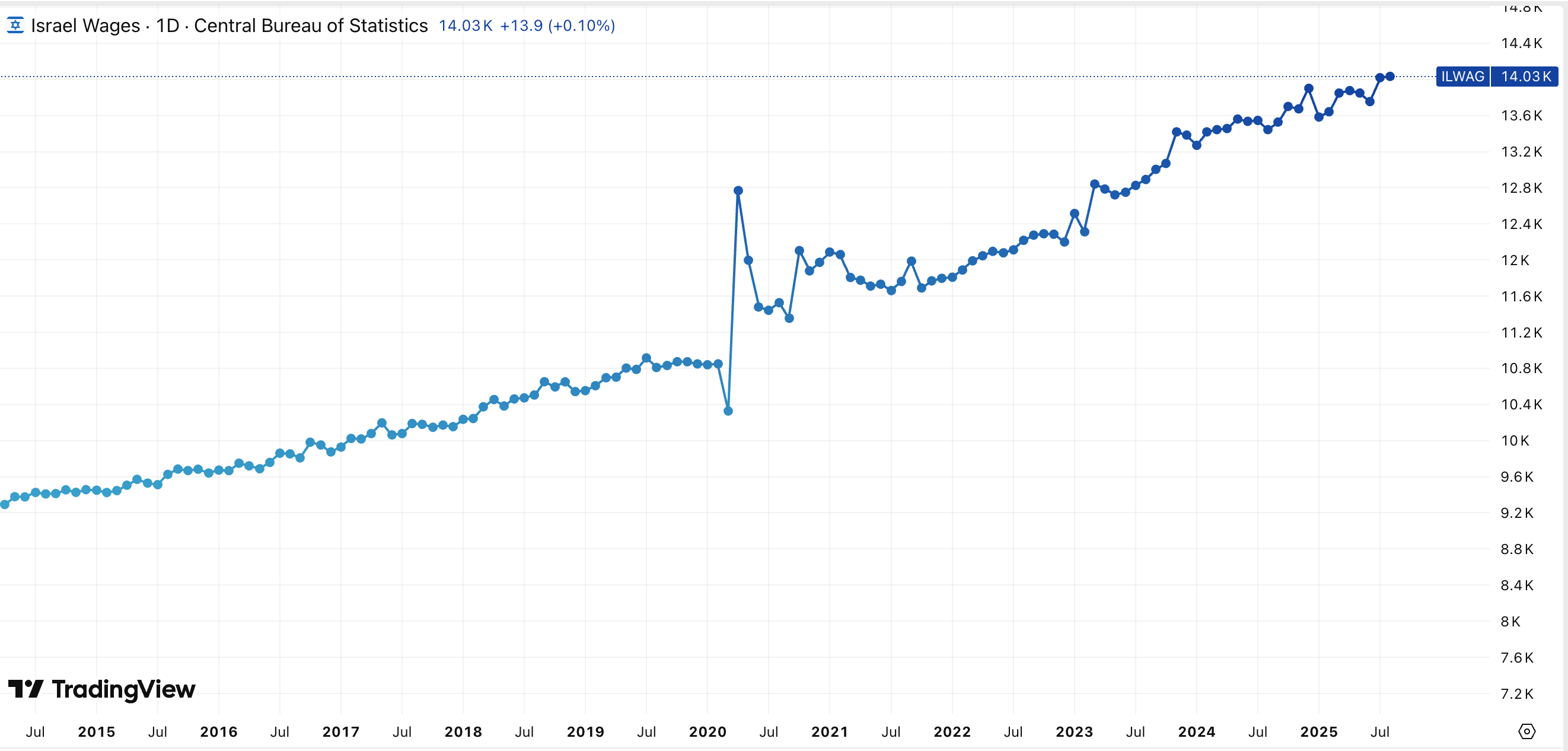
The average is a mathematical comfort blanket
One of the most misleading tools in economics is the average - a mathematical comfort blanket politicians wrap themselves in to avoid cold reality. The average suggests unity, a shared fate. But the latest data reveals the Israeli economy as a tale of two divergent realities.
This is what economists call “statistical blindness,” when aggregate data obscures individual experience. The national average suggests shared prosperity. But averages lie when distribution is lopsided. And in Israel, the distribution is extremely lopsided.
While tech salaries surged 6.3%, the vast majority of the workforce - teachers, nurses, service workers - saw real wages grow by just 0.2% after accounting for 2.5% inflation. Strip away the tech sector outliers, and Israel’s celebrated wage growth vanishes.
The inflation trap: an illusion of growth
We suffer from illusions about money, the tendency to think in nominal rather than real terms. A 2.7% raise feels like progress. But while the numbers rise, the value of the currency itself constantly erodes.
We see it in our morning ritual. Just a few years ago, a ₪10 coin was enough for a cappuccino. Today, that same coin leaves you in deficit. You are forced to dig deeper and add another ₪3 just to get the exact same cup.
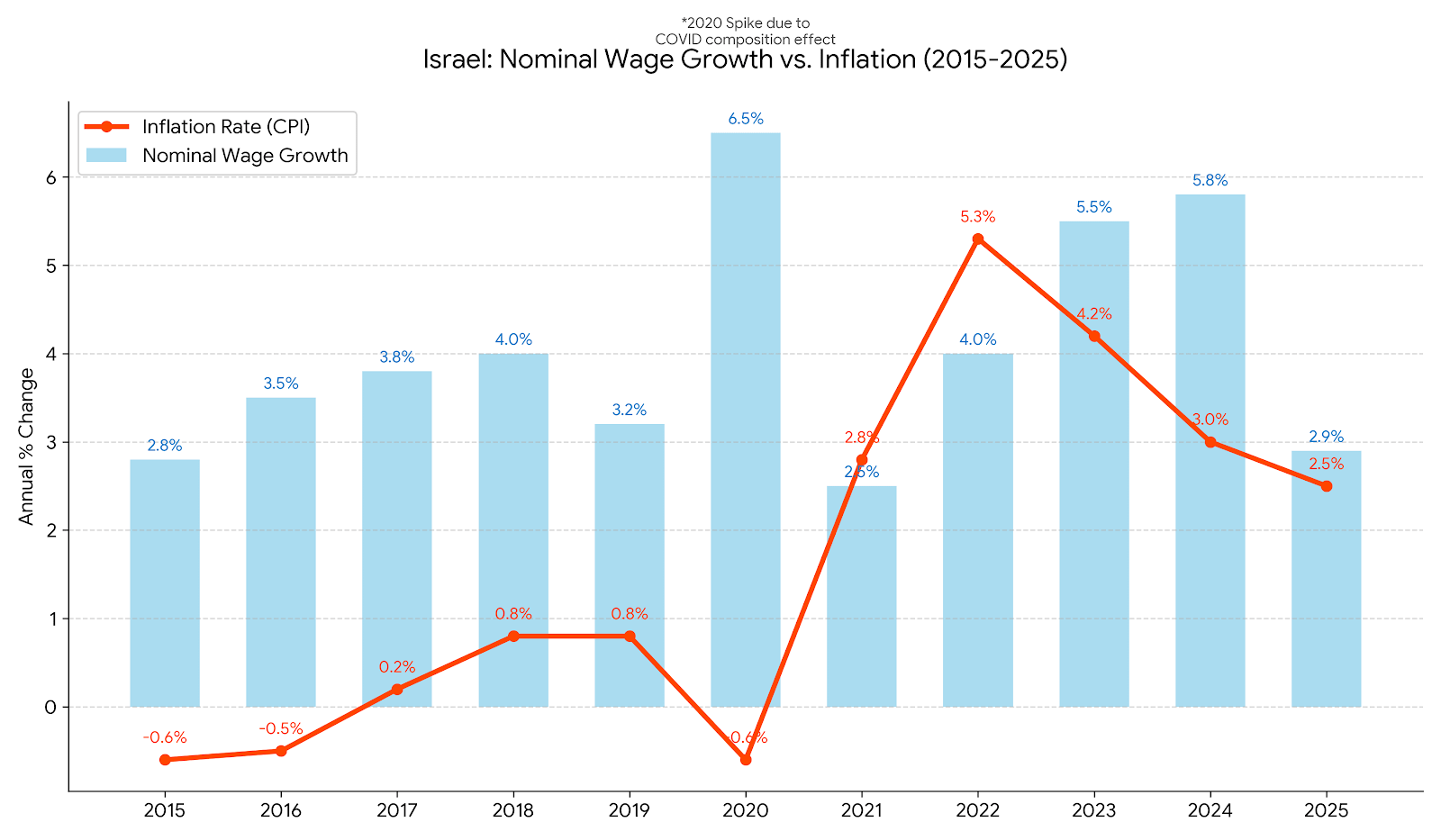
With inflation running at 2.5% (Bank of Israel, 2025), that raise evaporates before it hits your account.
Nominal growth: +2.7%
Real cost increase: +2.5%
The result: 0.2% real wage growth. Stagnation.
But average inflation is just as deceptive as average salary. The Consumer Price Index is a blunt instrument, a broad basket of hundreds of items. The middle and lower classes don’t buy the basket, they buy essentials. Their spending is heavily weighted toward food, where inflation has aggressively outpaced the general index.
The math is unforgiving: If your salary rose 2.7% but your grocery bill jumped 4%, you are empirically poorer today than a year ago.
But inflation is only part of what’s eating your paycheck.
High-tech distortion: an NBA player in a kindergarten
Another reason the data shows growth you don’t feel is the high-tech distortion.
The technology sector has essentially seceded from the local economy. With an average salary of ₪33,366, a surge of 6.3% (Central Bureau of Statistics, December 2025), it operates in a different stratosphere. This outlier effect exerts a gravitational pull on the national data, artificially inflating the average until it no longer resembles the typical worker’s reality.
Think of it this way - an NBA player walks into a kindergarten class. Suddenly, the average height shoots up. But none of the children grew taller. The statistic changed. The reality did not.
This is the Israeli labor market in 2025. The high-tech sector pulls the national average upward, masking stagnation among the middle class who make up the vast majority of the economy.
The numbers tell the story:
Tech workers: +6.3% nominal growth = +3.8% real growth (after inflation)
Everyone else: +2.7% nominal growth = +0.2% real growth (after inflation)
Tech workers are getting ahead. Everyone else is treading water.
The bottom line
We are witnessing the bifurcation of the economy. There is the export economy of high-tech, which beats inflation and imports global wealth. And then there is the domestic economy, which is slowly being ground down by the friction of rising prices.
If you feel the squeeze at the supermarket despite the celebratory headlines, don’t doubt your instincts. The real numbers prove you are right.
The “average” looks fine. This year, at least, ordinary people are not.
TV10 Global | Israel for Investors
Bringing you the top stories from the Israeli business community, by Israel’s only business and finance network.
Share your thoughts with us via: global@tv10.co.il or the Newsroom WhatsApp: +972-55-994-5851.
📧 Subscribe to our newsletter! And follow the daily conversation on 𝕏 @tv10global.
Pings available via WhatsApp Channel.