
🍿 Get our coverage on Spotify, and Youtube, too. Want to join the conversation? We’re on X
Quick takes:
Macro & Consumer Data: CBS data showed a 0.4% drop in domestic credit card spending; The Enforcement and Collection Authority reported a record ₪3.6 billion in debt collection for 2025.
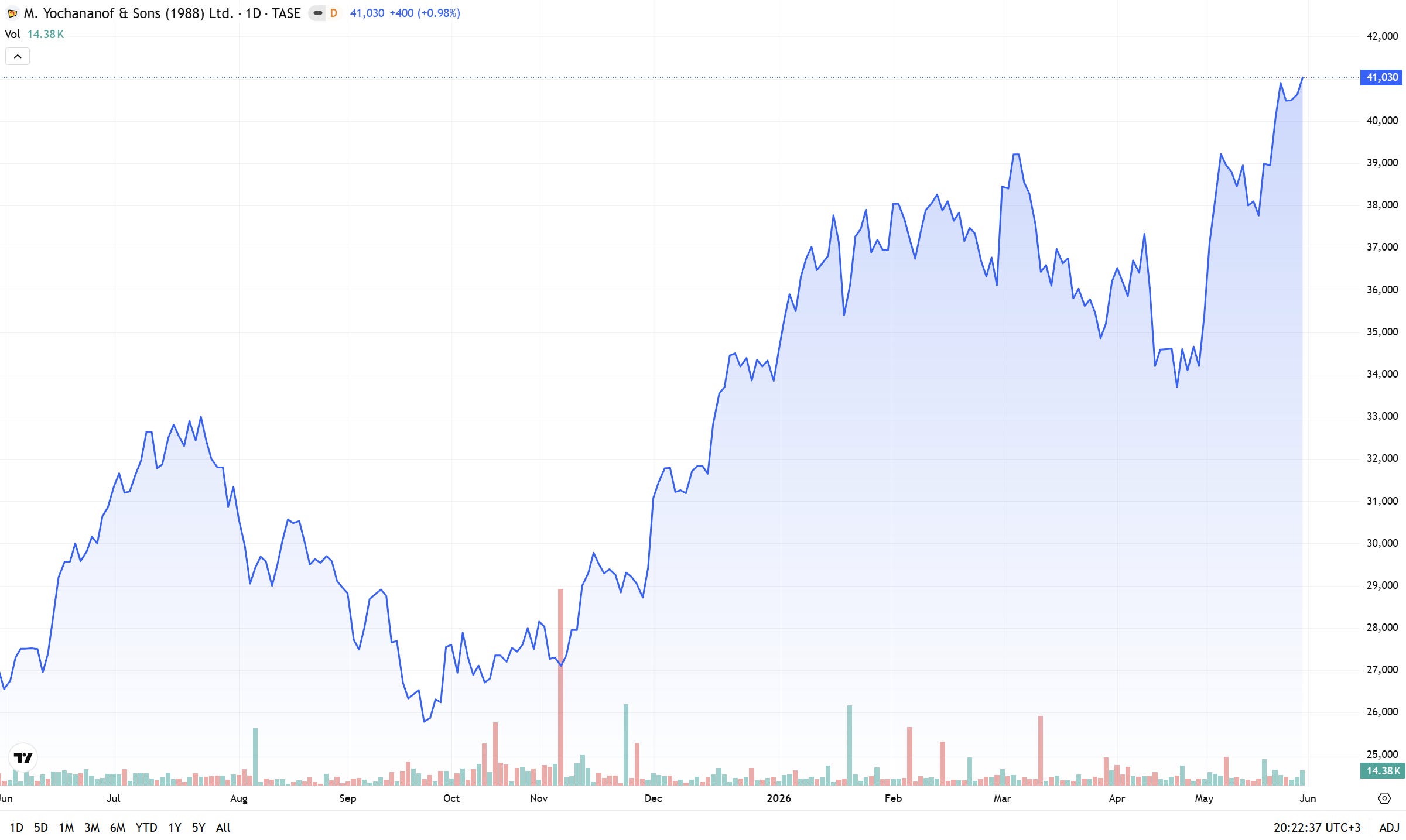
Food Retail: Supermarket giants Yochananof and Rami Levy both posted massive double-digit net profit surges, utilizing aggressive expansion and deep cash reserves to dominate consumer foot traffic amid a broader macro slowdown.
Regulation & Governance: Former Finance Minister Moshe Kahlon was convicted of securities reporting violations related to Unet Credit; the government approved a structural merger of the Consumer Council into the Consumer Protection Authority to streamline enforcement.
Macro & Consumer Data

New Central Bureau of Statistics (CBS) data indicates a contraction in the retail economy. Between February and April 2026, total domestic credit card purchases fell 0.4% YoY. While essential sectors like food and beverage grew by 6.8%, the geopolitical fallout from 'Operation Roaring Lion' severely impacted discretionary spending: the entertainment sector dropped 8.8%, and the flights, tourism, and hospitality sector cratered by 35.4%.
The Enforcement and Collection Authority (Hotzaa LaPoal) published its 2025 summary, revealing a record ₪3.6 billion in recovered debt, a 30% YoY surge. The Authority managed a staggering ₪27.4 billion in total outstanding liabilities across 360,000 newly opened cases, 51% of which were for debts under ₪5,000. Geographically, Bat Yam recorded the highest debtor concentration (8.3% of residents), while Bnei Brak recorded the lowest (3.1%). Notably, institutional creditors maintain a massive legal advantage, with 72% utilizing legal representation compared to just 28% of retail debtors.
Our take: The divergence between plunging discretionary spending and soaring debt collections is a macroeconomic tell - of a tapped-out consumer class. As geopolitical friction from the northern conflict traps domestic capital and halts outbound tourism, the Israeli consumer is forced to reallocate shrinking disposable income toward basic staples. Furthermore, the stark legal arbitrage in debt collection, where institutional creditors are heavily lawyered up against unrepresented retail debtors, highlights a structural imbalance that continues to squeeze the middle class. Unless core interest rates drop further to relieve household debt servicing costs, we expect consumer spending to remain hyper-focused on discount retail and essential commodities.
Food Retail

Supermarket chain Yochananof (TASE: YHNF) delivered a staggering Q1 2026 print, with total revenues climbing 19.2% YoY. Net profit surged 45.9% to ₪60 million, and operating profit jumped 31.6% to ₪97.5 million. The growth was heavily supported by a 14.9% increase in same-store sales. The board authorized a ₪25 million dividend distribution while noting a sharp 24.3% increase in management expenses, largely attributed to holiday-related charitable contributions. In a major corporate governance shift, the board announced that founder Mordechai Yochananof is stepping down as Chairman after 37.5 years, to be succeeded by Yoav Frieder.
Supermarket giant Rami Levy Hashikma Marketing (TASE: RMLI) mirrored this sector dominance, reporting a 15% revenue jump to ₪2.12 billion. While aggressive Passover discounting compressed gross margins slightly from 23.8% to 23.0%, the sheer volume of a 9.4% increase in same-store food sales easily absorbed the impact.
Operating profit climbed to ₪112 million, EBITDA jumped 20% to ₪201 million, and net profit surged 34% YoY to ₪74 million. The board approved a ₪58 million dividend. Rami Levy continues to aggressively scale its ecosystem, growing its mobile network to 472,000 subscribers, expanding Good Pharm, launching its first discount “Stock” format branch, and maintaining a massive ₪1 billion cash pile for strategic M&A.

Our take: The massive net profit surges from Yochananof (up 45.9%) and Rami Levy (up 34%) amid a national consumer credit crunch underscore the immense pricing power held by Israel’s food retail oligopoly. While the broader macro economy contracts and discretionary spending plummets, legacy supermarket chains are successfully passing inflationary and supply chain friction directly onto the consumer, extracting formidable yield.
Even as Rami Levy compressed gross margins slightly for holiday share-grabbing, their operational scale swallowed the costs effortlessly. Furthermore, Rami Levy’s ₪1 billion cash pile and Yochananof’s aggressive commercial real estate acquisitions signal a structural consolidation. As consumers aggressively downtrade, these big-box operators are monopolizing retail foot traffic and utilizing their cash-rich balance sheets to capture cross-sector arbitrage, expanding into pharmacies, telecom, and discount household goods to completely capture the shrinking Israeli wallet.
Regulation & Governance

The Tel Aviv District Court’s Economic Department convicted Moshe Kahlon, former Finance Minister and past Chairman of Unet Credit, of reporting offenses under the Securities Law. Under a plea agreement, Kahlon admitted to withholding critical information from the board and the public regarding material financial irregularities at the company’s Nazareth branch for over five months in early 2022. The prosecution is seeking a suspended sentence, a ₪180,000 fine, and an 18-month ban on serving as a public company officer.
The government approved a major bureaucratic consolidation, merging the independent Israel Consumer Council into the Consumer Protection and Fair Trade Authority under the Ministry of Economy. The move dismantles the Council, which has operated since 1970, and grants the unified Authority an additional ₪7.2 million in annual budgeting to expand enforcement and reduce systemic duplication.
Our take: The criminal conviction of a former Finance Minister serving as a public company chairman sends a smoldering signal to Israeli boardrooms regarding corporate transparency.
By enforcing strict securities laws and mandating public disclosures, the state is actively breaking down the institutional resistance that has historically shielded well-connected insiders from accountability.
Concurrently, consolidating consumer protection agencies is a targeted attempt to reduce bureaucratic bloat. By aligning Israeli regulatory efficiency closer to OECD standards, the Ministry of Economy is creating a centralized, capitalized watchdog to more effectively combat retail price gouging in a highly concentrated market.
TASE snapshot for Monday, June 1, 2026
TA-35 Index (TASE:TA35): 🔴 -4.21%
TA-90 (TASE:TA90): 🔴 -4.61%
TA-125 (TASE:TA125): 🔴 -4.31%
If you enjoyed this update, forward it on.
TV10 Global | Israel for Investors
Bringing you the top stories from the Israeli business community, by Israel’s only business and finance network.
Share your thoughts with us via: global@tv10.co.il or the Newsroom WhatsApp: +972-55-994-5851.
📧 Subscribe to this newsletter! And follow the daily conversation on 𝕏 @tv10global.
Disclaimer: This brief is for informational purposes only and does not constitute investment advice. All data current as of publication date.