


Editor’s note:
It’s a tale of two rate cuts - The Fed just cut rates for the third consecutive time, with inflation running ~40% above target, and the US government is burning through $1.2 trillion annually to service $38 trillion in debt. Markets may cheer, but the Fed is violating its core mandate: price stability. Meanwhile, Israel’s central bank faces a different situation: inflation is back in the target range, employment is strong, and state budgets are passing. The Bank of Israel needed to cut rates not despite this economic strength, but because of it - to prevent the shekel from strengthening too much. This time, the right monetary policy for Israel looks nothing like what’s right for the world’s largest economy.
— Eran Bar Tal, Editor-in-Chief, TV10
The quick read:
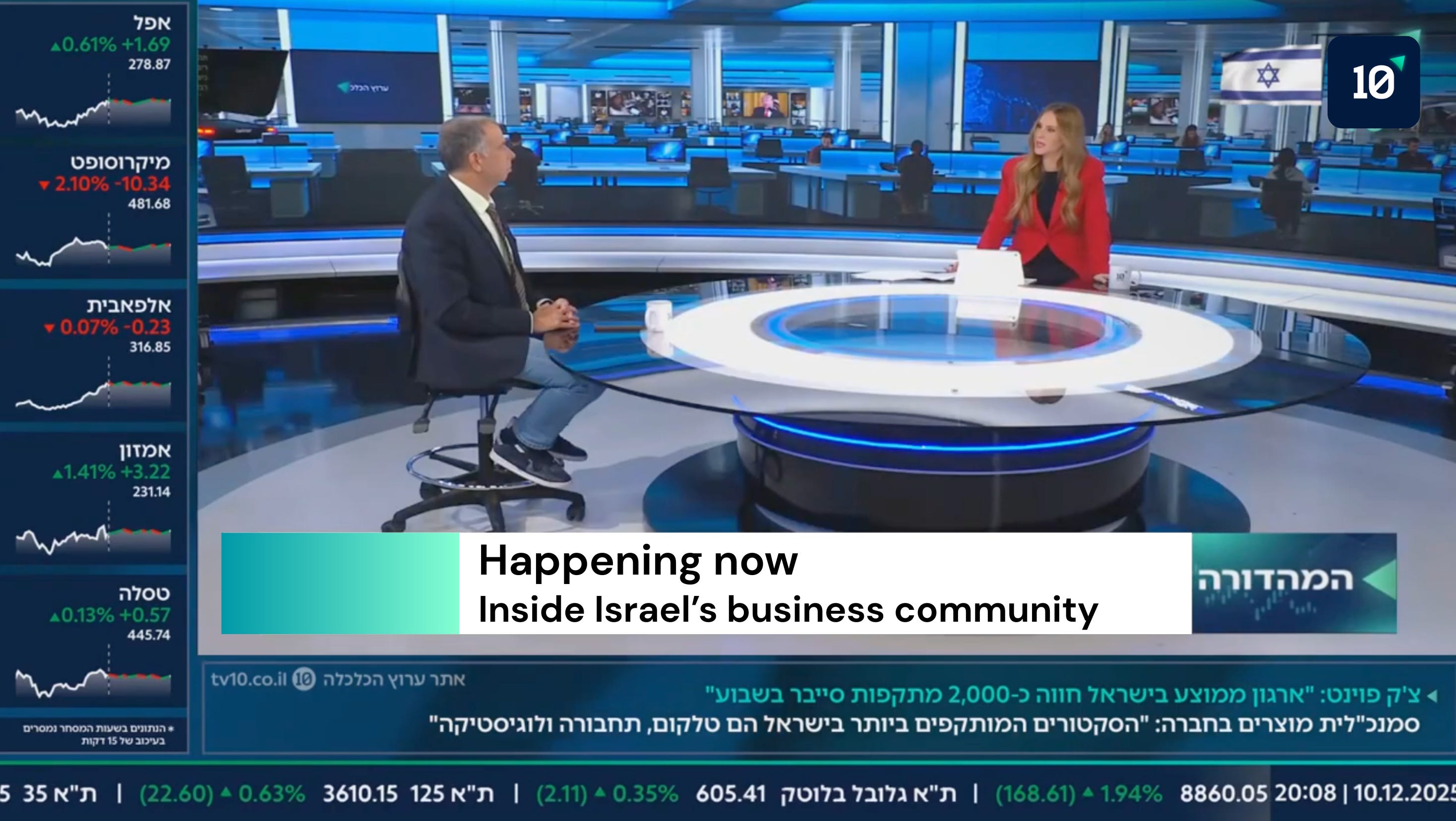
This week, we looked at three forces reshaping Israel’s economy.
First, international capital surged back into Israel: foreign direct investment hit $10.2B in H1 2025 (+35% YoY), global VCs led more Israeli Seed rounds than domestic funds for the first time (44 vs 35), and cyber funding reached an all-time high of $4.4B across 130 deals.
The pattern is clear. Foreign investors are betting on Israeli innovation despite ongoing conflict, with US capital accounting for 62% of FDI and software deals capturing 70% of transaction value.
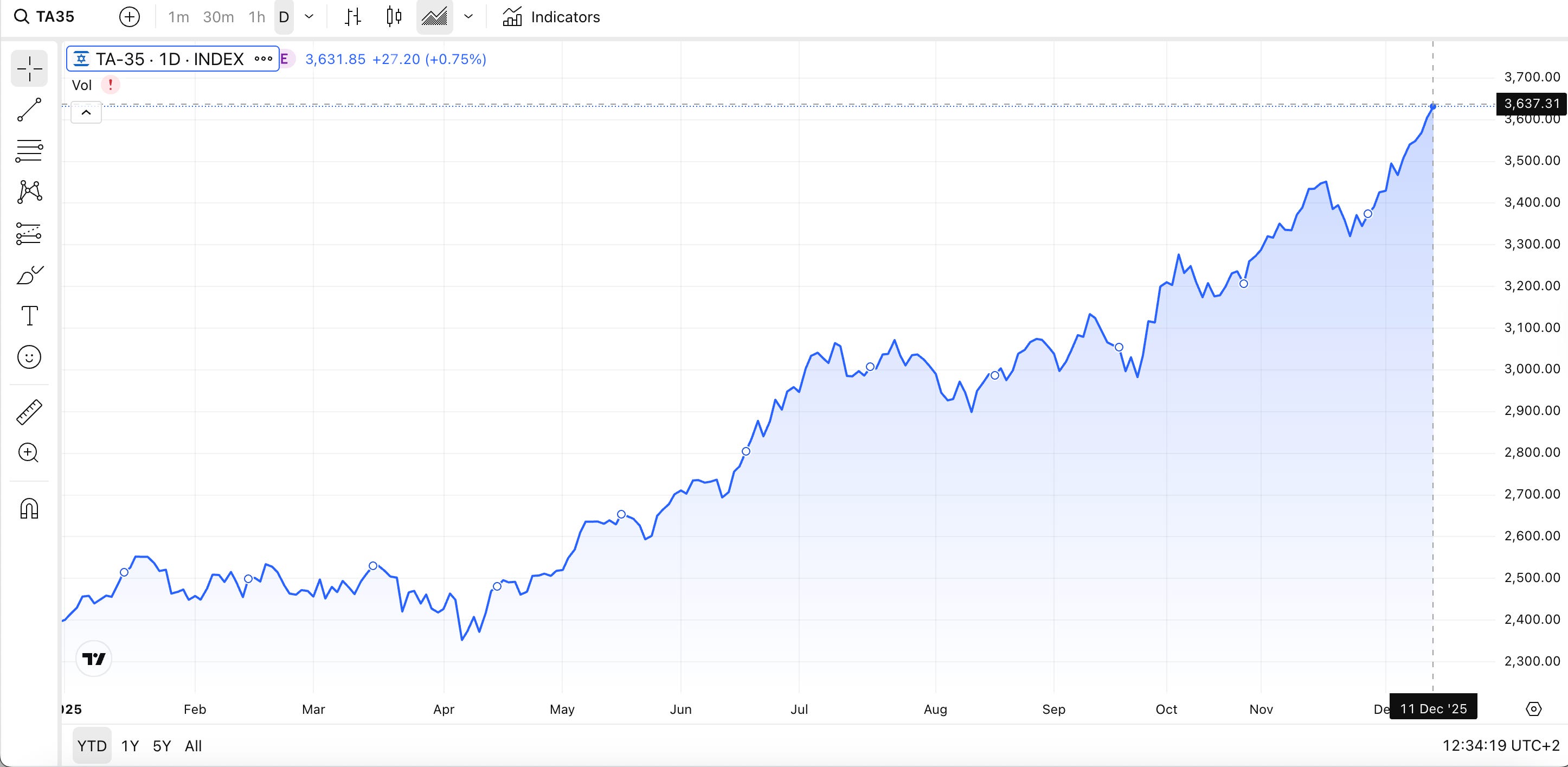
Second, Israeli markets hit absolute all-time highs, with the TA-35 (TASE:TA35) breaking records and top performers posting staggering YTD returns: Aryt (TASE:ARYT): +362%, Meitav (TASE:MTAV) +260%, and More Investment House (TASE:MRIN) +258%. The rally reflects both liquidity and a flight to quality, though More’s CEO Yossi Levy warned, “next year will likely see a correction.”
Third, we wrote about how wage data exposed a bifurcated economic reality: tech salaries jumped 6.3% to ₪33,366 while the average salary rose just 2.7% to ₪13,321, after 2.5% inflation, most workers saw real gains of 0.2%. The top 10% now cover 63% of direct taxes while the bottom 50% take home just 10% of total income. Consumer behavior mirrors the squeeze: retail revenue up only 2% during holidays (down from 6.9% prior) while credit card spending jumped 11.8%.
This past week, TV10 covered Real Estate City, a huge industry conference in Eilat, attended by 2,000 industry professionals. No one at the conference was willing to admit the existence of the obvious crisis: developers are postponing deals, and it’s difficult to raise money for residential projects.
This is another reason why the Bank of Israel must lower the interest rate in order to return this industry to a growth path - real estate is still considered one of the main growth drivers in the market. According to data from the Chief Economist at the Ministry of Finance, which was published last Wednesday, apartment sales in October were 12% lower than the same month last year. This is an especially weak month compared to the last two and a half decades. This is more than just a warning sign.
Onwards.
Institutional investment in Israeli real estate surges in 2025
✉️ Notes by Moshe Maimon, Head of TV10 Capital Markets
Despite a slowdown in the Israeli real estate market, 2025 has emerged as a watershed year for the Israeli real estate sector, characterized by a massive influx of institutional capital. Major Israeli insurance companies and investment houses have aggressively increased their exposure to local developers to capitalize on attractive valuations, anticipating a turn in the market cycle.
Strategies we’ve seen institutionals employ:
Menora Mivtachim (TASE:MMHD) adopted an active financial developer role, injecting capital directly into projects to bypass high financing costs. Notable moves included a ₪110 million investment in Luzon Group (TASE:LUZN), a ₪200 million joint venture with Hachsharat HaYishuv, and a strategic stake in Prashkovsky (TASE:PRSK).
Conversely, Harel (TASE:HARL) acted as an alternative bank, leveraging its massive Nostro account to provide credit and equity, most notably joining Menora in a ₪234 million injection into Y.H. Dimri (TASE:DIMRI) to secure its place in the Tel Aviv-35 index.
Israel Canada (TASE:ISCN) proved to be a magnet for capital, raising ₪125 million from Phoenix (TASE:PHOE), More (TASE:MRIN), and Migdal (TASE:MGDL) to reduce leverage, while partnering with Clal Insurance (TASE:CLIS), which acquired 15% of Israel Canada subsidiary ICR at a ₪1.72 billion valuation.
Clal also backed Boney Hatichon (TASE:BOTI) with ₪250 million for urban renewal projects, while Migdal focused on long-term stability through financing deals with Shikun & Binui (TASE:SKBN) and an equity stake in Almogim (TASE:ALMA).
The bottom line:
Ultimately, 2025 represents the return of smart money to the local market. Institutions utilized the high-interest environment to secure discounted equity and favorable terms. As the market looks toward more potential interest rate cuts in 2026, these entities are well-positioned to reap significant rewards from the sector’s anticipated recovery.
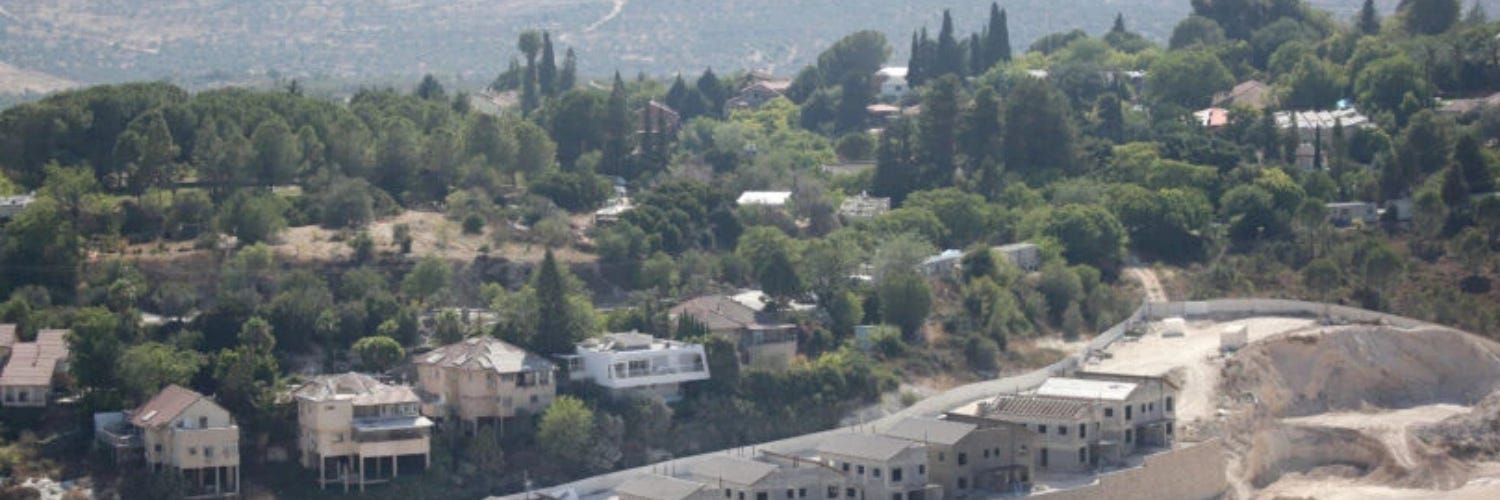
“Not investing in Judea & Samaria was a mistake.”
At a major real estate conference last week in Eilat covered by TV10, we heard from developers who invest in real estate in Judea and Samaria, who presented their profits. Those who had not invested in the region, like Nachshon Kivithi, one of the owners of the BSR Group, characterized it as “a mistake.” Kivithi said that the group is going to invest in a complex in Ma’ale Adumim.
Approvals for energy and transportation projects
In the 2026 state budget, an investment of 3 billion shekels in transportation infrastructure in Judea and Samaria was approved. Most transportation investments target Israel’s densest areas, in the light rail, the metro, and the roads.
Our take: People decide where to live based on property prices and commute times. More investments in transportation outside the densely populated areas would serve the public interest.
Attorney Essam Hamed, the former attorney general of Judea and Samaria, reported that huge renewable energy projects in the area have already been approved, along with the construction of two power plants in the region.
Shai Alon, head of the Beit El local council, spoke about urban renewal in the community, about secular populations in the community, and about the saturated construction in high-rise buildings there. The need for this construction stems from the fact that demand is greater than the supply of land in the community, which has not received a permit to expand.
As Israel continues to crowd development between Hadera and Gedera, the country neglects developing residential communities in the Galilee, the Golan and the Negev.
Next week:
As we gear up to celebrate Hannukah, we’ve got a new Comment section on our website, which you can subscribe to separately. There, we will be doing deeper dives into certain topics. If you’d like us to consider your comment for submission to the site, please email us at the contact information below.
That’s our letter, folks. If you enjoyed this Weekly, please forward it to a friend.

The English TV10 newsletter is edited by Sophia Tupolev. Share your thoughts!
TV10 Global | Israel for Investors
Now in English: Bringing you the top stories from the Israeli business community, by Israel’s only business and finance network.
Please share your thoughts with us via: global@tv10.co.il or the Newsroom WhatsApp: +972-55-994-5851.
📧 Subscribe to this newsletter! And follow the daily conversation on 𝕏 @tv10global.
Pings with new editions are also available via our WhatsApp Channel.
Disclaimer: This brief is for informational purposes only and does not constitute investment advice. All data is current as of publication date.