
🍿 Get our coverage on Spotify, and Youtube, too. Want to join the conversation? We’re on X
Quick takes:
Macro: Israel’s Q1 2026 GDP contracted by 3.8% annualized, further compounded by a 0.4% drop in the May economic activity index.
Agriculture: The Ministry of Agriculture has approved a ₪50 million direct subsidy package for grazing cattle breeders to protect open lands.
Financial Vandalism: A UK court has sentenced four ‘Palestine’ Action activists to over 20 years in combined prison terms for a 2024 raid on an Elbit Systems UK facility.
Macro

The Central Bureau of Statistics (CBS) released its second estimate for Q1 2026 national accounts, confirming that Israel’s Gross Domestic Product (GDP) contracted by an annualized 3.8% (-1.0% on a quarterly basis) relative to Q4 2025. The contraction was heavily catalyzed by the domestic economic strains of Operation Roaring Lion, which drove private consumption down by 5.0% annualized, led by a 10.2% drop in per capita current expenditure on food, housing, and essential services.
Civic public spending also retrenched by 26.9%, contrastingly offset by a 9.6% increase in direct defense outlays. Despite the headline contraction, underlying corporate indicators showed strong resilience: fixed asset investments bounded upward by 12.8% annualized, fueled by a staggering 61.6% explosion in information and communication technology (ICT) capital expenditure, while industrial exports stripped of diamonds and startups jumped 13.6%.
Corroborating this cooling cycle, the monthly index for economic activity fell by 0.4% in May, signaling a growth rate trailing below its long-term trend of 0.3%. The index, which estimates the average monthly growth from March to May, was dragged down by weak industrial production, trade, and services output from March, alongside depressed consumer imports and lower indirect tax revenues in May.
The contraction was partially mitigated by resilient credit card purchasing volumes, healthy goods exports, and rallying equity indices across the TASE and Nasdaq. Reflecting the deeper macroeconomic drag, economic activity figures for the trailing two months were also revised downward.
Our take: The juxtaposition of an annualized 3.8% GDP contraction and a cooling 1.9% inflation rate highlights a highly segmented wartime economy rather than a systemic structural collapse. The contraction is predominantly a function of supply-side labor friction and compressed consumer velocity, which are typical during high-intensity regional security shocks. However, the 12.8% surge in fixed investments, anchored by the massive 61.6% ICT investment spike, indicates that institutional capital and multinational technology firms are aggressively doubling down on local R&D capacity and intellectual property retention, viewing the current macro environment as a cyclical entry window.
Agriculture

The Ministry of Agriculture and Food Security has formalized a ₪50 million direct fiscal support framework for grazing beef cattle, buffalo, and deer breeders for the 2026 fiscal year. The capital deployment is specifically targeted at strengthening sovereign agricultural assets situated along national border lines and high-friction confrontation zones in the North and the Negev. Operating under direct subsidy mechanics established under historical agricultural structural reforms, the financial allocations will be benchmarked against herd size and total managed acreage.
According to ministry data, Israel’s grazing sector comprises approximately 300 industrial breeders managing 1.8 million dunams of open land. Beyond direct food security provisions, the government explicitly treats grazing infrastructure as a strategic public service; the physical presence of herds reduces volatile biomass fuel loads, limiting the spread of regional wildfires caused by military activity, while structurally preventing illegal land seizures on state territory.
Our take: While a ₪50 million allocation appears marginal within the context of the broader state budget, its structural return on investment is highly significant for sovereign risk management. Periphery agriculture in high-conflict zones cannot survive on pure market-driven venture yield due to extreme geopolitical friction, insurance premiums, and systemic disruption. By transitioning to an aggressive direct subsidy model, the state is underwritten to protect a critical geographical buffer. From an institutional perspective, maintaining these breeders is a highly cost-efficient method of safeguarding 1.8 million dunams of sovereign territory from real estate degradation and illegal encroachment, transforming traditional land management into an essential component of national defense and supply chain resilience.
Financial Vandalism

A UK Crown Court has handed down definitive prison sentences totaling more than 20 years to four pro-’Palestinian’ activists affiliated with the illegal group ‘Palestine’ Action following a destructive 2024 raid on an Elbit Systems (TASE:ESLT) UK manufacturing plant in Bristol. The defendants, Samuel Corner, Charlotte Head, Leona Camieu, and Fatema Zainab Rajwani, were convicted of criminal damage after destroying over £1 million worth of military drone assemblies, mainframes, and IT infrastructure.
Corner, who additionally assaulted a police officer with a sledgehammer, received seven years and eight months in prison, while his co-conspirators received terms ranging from four to five years. In a critical jurisprudential development, the presiding judge applied prolonged sentences after determining the corporate sabotage carried a distinct connection to terrorism. Corporate filings verified that Elbit Systems UK successfully recovered nearly £1.2 million from its insurance underwriters to cover asset replacement costs, though management noted substantial operational friction regarding workforce security.
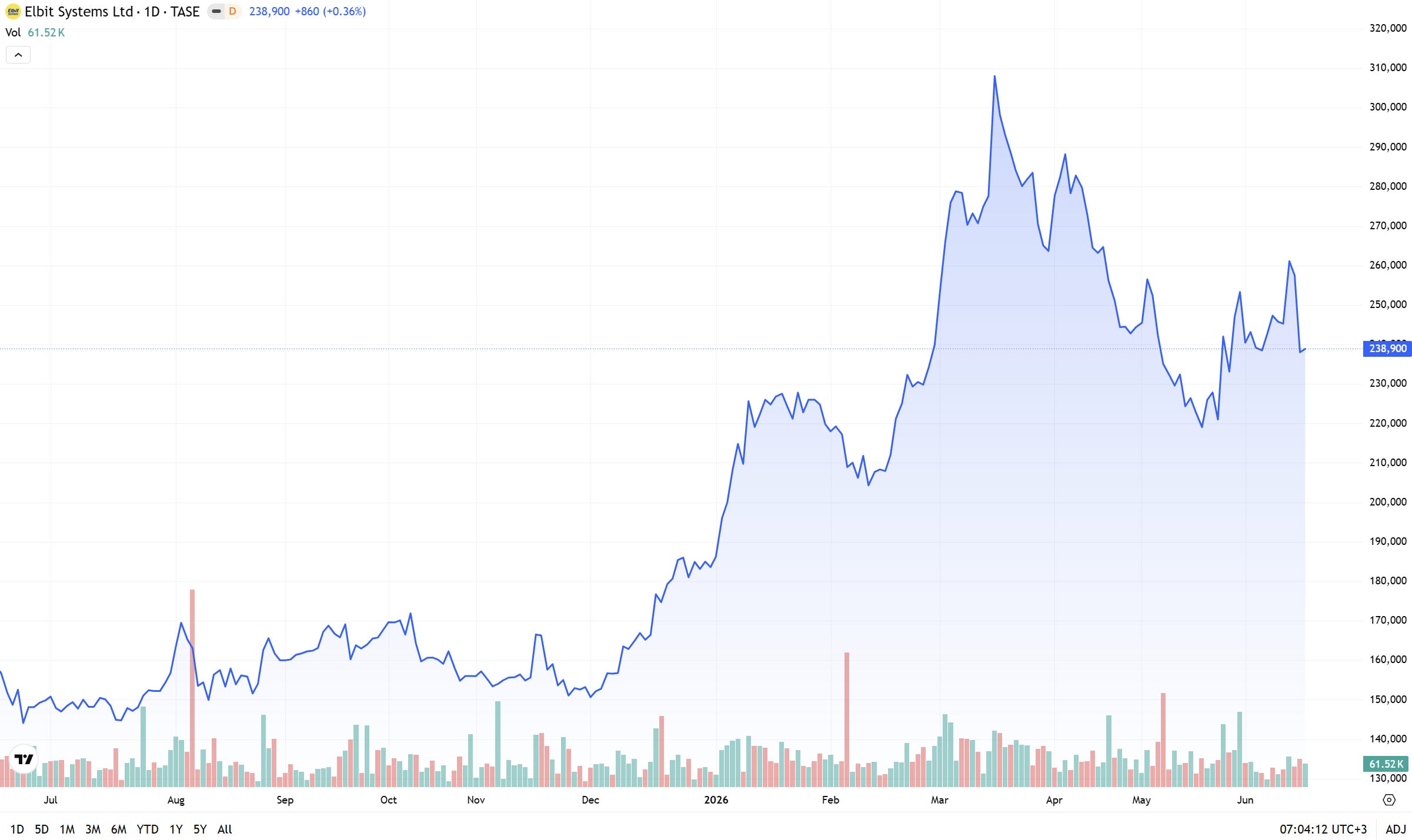
Our take: The UK judiciary’s decision to attach a legal terrorism premium to corporate property destruction marks a major institutional shift that protects foreign defense contractors. For years, domestic and international defense enterprises operating in Western Europe faced systematic asymmetric risks from activist groups exploiting lenient local trespass and vandalism laws to disrupt supply chains. By establishing that ideological asset destruction carries severe criminal liability, British courts are creating an essential deterrence framework. For institutional shareholders in Elbit Systems, this mitigates long-term operational risk and ensures that critical aerospace export pipelines remain physically insulated, while verifying that global insurance syndicates continue to fully absorb the immediate fiscal shocks of geopolitical vandalism.
TASE snapshot for Wednesday, June 17, 2026
TA-35 Index (TASE:TA35): 🔴 -1.54%
TA-90 (TASE:TA90): 🔴 -2.03%
TA-125 (TASE:TA125): 🔴 -1.72%
If you enjoyed this update, forward it on.
TV10 Global | Israel for Investors
Bringing you the top stories from the Israeli business community, by Israel’s only business and finance network.
Share your thoughts with us via: global@tv10.co.il or the Newsroom WhatsApp: +972-55-994-5851.
📧 Subscribe to this newsletter! And follow the daily conversation on 𝕏 @tv10global.
Disclaimer: This brief is for informational purposes only and does not constitute investment advice. All data current as of publication date.