
🍿 Get our coverage on Spotify, and Youtube, too. Want to join the conversation? We’re on X
Quick takes:
Macro & Regulation: The Capital Markets Authority issues aggressive new directives holding institutional investors liable for verifying the legitimacy of early pension withdrawals; The Knesset Finance Committee approves hundreds of millions of shekels in localized stimulus and conflict compensation, despite fierce resistance from legal advisors over illegal retroactive budget allocations.
Markets: The Strauss Group and Ayalon Investment House are officially added to the government’s concentration watchlists, triggering strict cross-ownership and infrastructure bidding limits.
Macro & Regulation

The Capital Markets, Insurance, and Savings Authority, led by Commissioner Amit Gal, has launched a sweeping reform to combat predatory attempts to lure the public into early pension withdrawals. Under the new directives, the regulatory burden is shifted entirely onto institutional bodies, insurance companies and investment houses. Institutions can no longer rely on submitted paperwork; they must proactively verify termination of employment directly with government databases, cross-reference tax exemption certificates with the Tax Authority (SHAAM), and authenticate inheritance orders via the Ministry of Justice. Crucially, before executing any pre-retirement withdrawal, the institution must initiate direct contact with the saver, unmask any unlicensed brokers involved, and explicitly detail the severe financial consequences, including a 35% tax penalty and permanent damage to future annuity payouts.
Our take: This aggressive intervention by the Capital Markets Authority exposes a highly concerning arbitrage in Israel’s retail financial sector. Unlicensed brokers have been exploiting the economic distress of the middle class, exacerbated by inflation and localized conflict, by skimming exorbitant fees off financially destructive early pension liquidations.
By forcing the institutional bodies (the insurers and investment houses) to act as the ultimate gatekeepers, the regulator is acknowledging that financial literacy alone cannot protect the consumer. This structural fix effectively kills the business model of these predatory consultants by introducing massive compliance friction into the withdrawal process. For the institutional players, however, this represents a significant increase in operational overhead and regulatory liability, forcing them to overhaul their digital verification architecture to avoid draconian fines for unauthorized capital flight.

The Knesset Finance Committee approved hundreds of millions of shekels in budgetary transfers for 2026, primarily aimed at localized economic recovery following ‘Operation Roaring Lion’ and regional development. The allocations include ₪191M to the Ministry of Welfare and ₪183M to the Ministry of Tourism to compensate hotels housing evacuees. An additional ₪586M in future commitments was authorized for the Negev and Galilee regions. However, the approvals were overshadowed by a fierce legal confrontation. The Committee's legal counsel accused the Ministry of Finance of illegal conduct regarding a ₪52M transfer to the Prime Minister’s Office, partially earmarked for Haredi socioeconomic development. The Treasury admitted to retroactively seeking approval for a ₪7M overrun on contracts already executed. The legal counsel unequivocally rejected this ‘fait accompli’ budgeting, demanding the Treasury cease manufacturing deliberate deficits and threatening to freeze future approvals until the Ministry commits to lawful budgeting procedures.
Our take: The clash inside the Finance Committee is a textbook example of fiscal dominance overriding institutional guardrails. The Ministry of Finance is utilizing the genuine macroeconomic crisis generated by ‘Operation Roaring Lion’ to simultaneously push through highly partisan, coalition-mandated capital allocations.
When the Treasury executes contracts prior to parliamentary approval, relying on the political necessity of wartime stimulus to force the committee’s hand, it fundamentally breaks the chain of fiscal accountability. This is not a localized bureaucratic spat; it is a red flag for foreign debt buyers. If the state’s budget architecture allows ministries to unilaterally generate off-book deficits and strong-arm the legislature into retroactive approvals, the integrity of the 2026 deficit target is inherently compromised. Institutional investors tracking Israeli sovereign debt will view this institutional resistance from the legal counsel as the last line of defense against systemic fiscal indiscipline.
Capital Markets

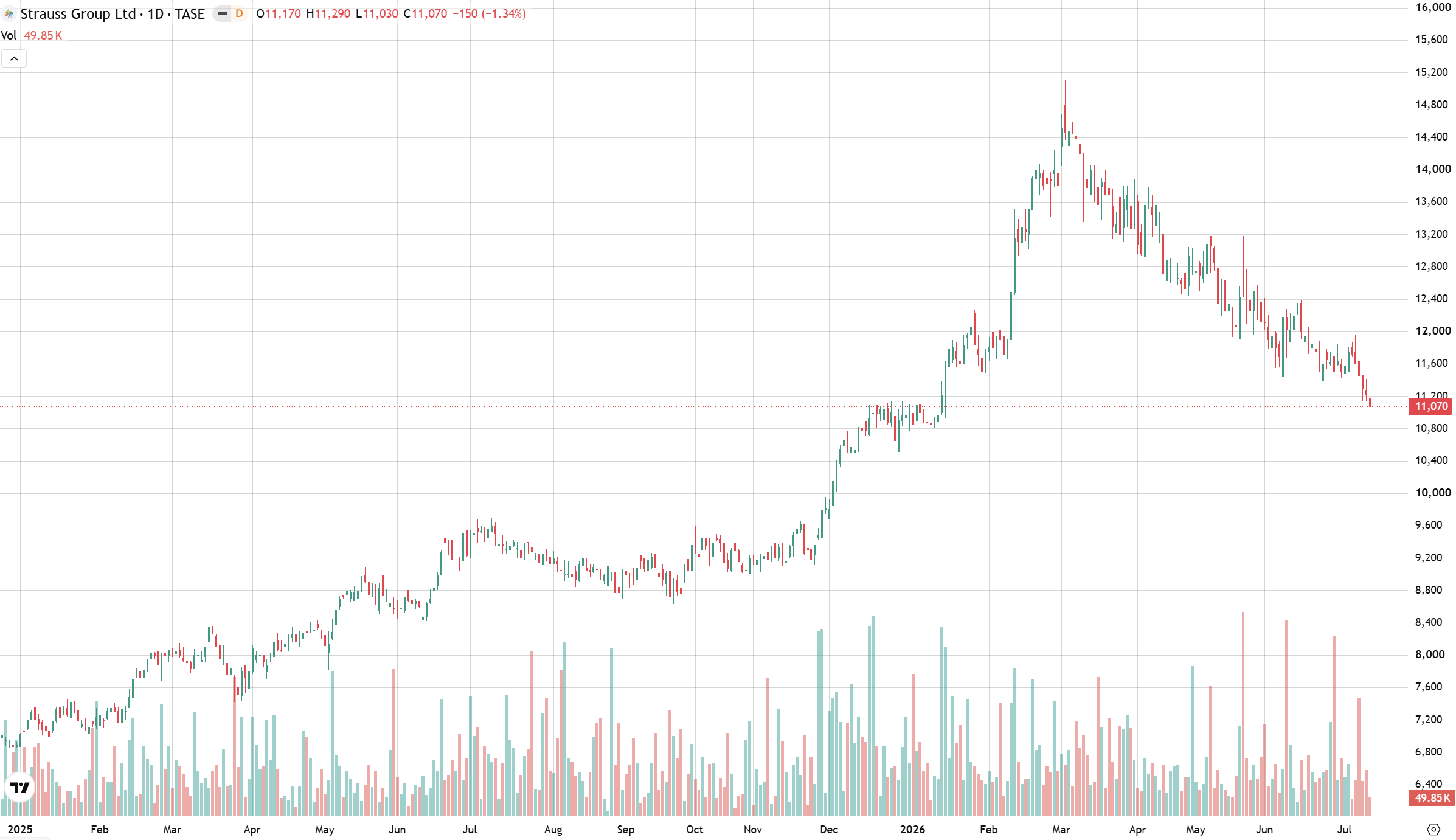
The Committee for the Reduction of Concentration has officially added both the Strauss Group (TASE: STRS) and Ayalon Investment House (TASE: AYAL) to its statutory watchlists of highly concentrated macroeconomic entities. Strauss Group, alongside controlling shareholders Ofra, Adi, and Irit Strauss, entered the ‘Significant Real Corporation’ list after the food and beverage giant’s 2025 consolidated sales surpassed the ₪7B statutory threshold.
Concurrently, Ayalon Investment House, led by controlling shareholder Noam Brurman, was designated a ‘Significant Financial Entity’ due to a surge in its assets under management (AUM). Israel’s concentration map now encompasses 91 business groups. Consequently, both entities now face immediate, hard-coded regulatory friction: they are barred from cross-holding real and financial assets to prevent systemic risk, and any future attempt to bid on privatized government companies or vital infrastructure licenses will require mandatory vetting by the Concentration Committee.
Our take: The inclusion of Strauss and Ayalon onto the concentration list is not merely an administrative milestone; it is a structural ceiling on their domestic capital allocation strategies. Israel’s anti-concentration laws are uniquely designed to dismantle the pyramidal, family-controlled holding structures that historically stifled domestic competition.
For Strauss, the ₪7B revenue threshold is a double-edged sword. While it signals robust pricing power in the domestic food cartel, the subsequent regulatory straitjacket means the company is effectively blocked from vertically integrating into adjacent infrastructure or financial monopolies. For foreign institutional investors, this highlights the profound regulatory layering inherent in the Israeli market: success breeds statutory containment. These conglomerates are now forced to either deploy excess capital abroad or distribute heavy dividends, as the domestic M&A and infrastructure pathways are now severely obstructed by regulatory mandate.
TASE snapshot for Monday, July 13, 2026
TA-35 Index (TASE:TA35) 🟢 +0.07%
TA-90 (TASE:TA90): 🔴 -0.47%
TA-125 (TASE:TA125): 🔴 -0.07%
If you enjoyed this update, forward it on.
TV10 Global | Israel for Investors
Bringing you the top stories from the Israeli business community, by Israel’s only business and finance network.
Share your thoughts with us via: global@tv10.co.il or the Newsroom WhatsApp: +972-55-994-5851.
📧 Subscribe to this newsletter! And follow the daily conversation on 𝕏 @tv10global.
Disclaimer: This brief is for informational purposes only and does not constitute investment advice. All data current as of publication date.