

Editor’s note:
Editor’s note: The lopsided distribution of global private equity inside Israel’s sovereign boundary is best exemplified by the cybersecurity sector’s absolute dominance. While mega-rounds like Cyera’s $12 billion valuation are heralded as triumphs of national resilience, they mask a dangerous hyper-concentration of capital. Global allocators are treating elite tech platforms as highly secure system assets, aggressively scaling their private marks. This artificially engineers balloon valuations, a dynamic playing out globally as SpaceX hits the public markets at a staggering $1.75 trillion valuation. By the time these mega-caps transition to public listings, institutional venture funds have already extracted the bulk of the fundamental margin. The public offering simply functions as an exit liquidity event, dumping heavily bloated assets onto a retail public locked out of early-stage wealth creation by accredited investor laws and strict capital controls.
This hyper-selective capital concentration is starkly illuminated by a comprehensive report published this week by Poalim Tech, backed by Bank Hapoalim (TASE:POLI), and Dealigence. The data reveals that while Israeli startups secured an impressive $8.6 billion in venture financing during the first half of 2026’ marking a robust 45% YoY surge in absolute dollar volume’ the actual number of discrete funding rounds plummeted by 35%. This macroeconomic paradox perfectly illustrates the Cantillon effect at work within the ecosystem: aggregate capital flows are expanding, yet the liquidity is consolidating into a diminishing pool of late-stage system assets and serial founders, leaving the broader early-stage pipeline starved of essential diversification.
In this week’s Deep Dive, we pierce through the retail theater of multi-billion-dollar marks to deconstruct the macro drivers fueling this extreme capital concentration. We will analyze the structural mechanics of balloon valuations that inevitably force the retail class to absorb the downstream margin compression and outline the exact border deregulation and capital portability reforms required to rescue Israel's foundational venture pipeline.
— Sophia Tupolev, TV10 Global Editor
TASE weekly snapshot
The Tel Aviv Stock Exchange closed the week on a positive note.
TA-35 Index (TASE:TA35): 🟢 +1.77%
TA-90 (TASE:TA90): 🟢 +0.49%
TA-125 (TASE:TA125): 🟢 +1.43%
For more, read our daily editions from Monday to Wednesday - and now, get our video and audio updates on Spotify.
The cyber windfall: who cashes in first?

The lopsided distribution of global private equity inside the sovereign boundary is best exemplified by the pronounced weighting of the cybersecurity sector. During the height of regional escalations in March, the domestic cyber industry effortlessly commanded $580 million in a single month. This trend reached a notable apex with Israeli data and AI security juggernaut Cyera, which recently closed a $600 million financing round. The mega-round elevated Cyera’s valuation to $12 billion, a rapid expansion from the $9 billion valuation it printed just months prior in January.

While these multi-billion-dollar corporate milestones highlight the undeniable resilience of Israeli engineering, classical economic theory suggests a more complex mechanism at play. Global allocators are treating elite tech platforms as highly secure system assets, aggressively scaling their private marks. This hyper-concentration can occasionally trigger Greater Fool dynamics, where private valuations are sustained by the assumption of persistent premium multiples, independent of underlying intrinsic yield. Ultimately, the retail investor is forced to navigate the downstream effects of these valuations. This is a standard global venture capital cycle. Look no further than SpaceX, which just went public. Only 18 months ago, the company was privately valued at roughly $350 billion; today, it enters the public markets at a staggering $1.75 trillion, a 5X valuation multiple engineered largely in the unlisted market.

By the time these capitalized mega-caps transition from private to public listings, institutional venture funds have generally captured the bulk of the fundamental margin. Applied psychological principles of Prospect Theory, specifically how risk and future upside are framed to retail buyers, show how public offerings often function as an institutional liquidity event. Premium assets are transferred to a retail public that remains structurally locked out of early-stage wealth creation by accredited investor laws and capital controls. The retail consumer is a perfectly rational actor seeking yield, but they are constrained by an environment that forces them to participate at the peak of the private valuation cycle.
When private hype meets public reality
When technological narratives undergo structural recalibration, the subsequent market corrections are disproportionately absorbed by the retail class due to asymmetric information, the inherent imbalance where corporate insiders possess granular insight into systemic vulnerabilities while public buyers rely on standardized disclosures.
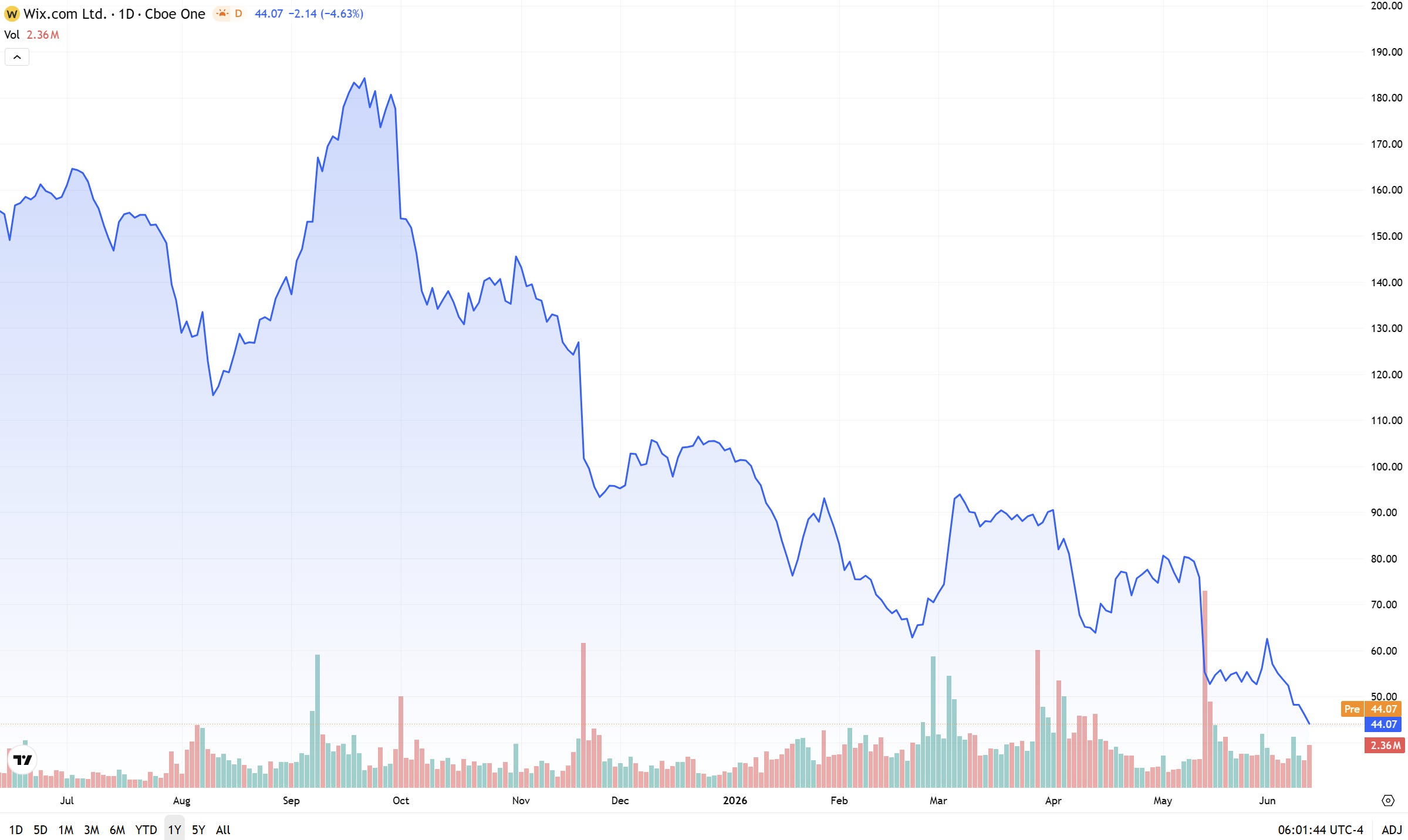
The recent trajectory of legacy tech giant Wix (NASDAQ:WIX) serves as an instructive case study of a public company confronting actual market friction. Over the past 12 months, Wix’s stock has declined by 78%, representing a significant erasure of capital. As AI-driven automated ‘vibe coding’ applications begin to challenge the company’s core product and an management team that refused to face reality, the market valuation has contracted under the weight of shifting technological realities and higher interest rates.
The retail investors who allocated capital to the Wix growth story were uninformed participants responding to news theater; they were simply operating within a financial establishment that occasionally leans heavily on performative interventions to maintain confidence. Early institutional backers who capitalized these companies secured their arbitrage long ago, efficiently rotating their capital into the next cycle of unlisted AI and cyber infrastructure. This dynamic reflects the principal-agent problem, where the liquidity timelines of managing financial institutions do not always perfectly align with the long-term wealth preservation needs of the broader public.
The price of captive capital

To ensure the sustainable evolution of Israel’s technology funnel and shield the consumer from structural market imbalances, policymakers must address the regulatory capture that currently insulates local incumbents. According to classical public choice theory, when a government maintains high administrative barriers, it inadvertently incentivizes corporate rent-seeking, where firms expend resources to secure regulatory advantages rather than generating pure economic value. The primary bottleneck to seed-stage vitality is not a deficit of domestic talent, but the layer of administrative and regulatory friction restricting cross-border capital mobility. The government must systematically eliminate the bureaucratic friction governing foreign venture funds, streamline corporate tax portability, and ease foreign exchange restrictions that penalize early-stage firms during shekel-dollar fluctuations.
True structural reform also requires introducing deeper competition into the domestic credit market. Opening the local financial sector to international tech-focused commercial banks and foreign venture debt syndicates would introduce much-needed capital portability, strip legacy domestic banks of their restrictive lending power and reducing transactional friction.
Furthermore, optimizing trade frameworks, such as dismantling import quotas on necessary physical server infrastructure, reducing silent taxes on imported institutional office goods, and minimizing the regulatory layering required to execute cross-border corporate reorganizations, would allow young companies to maintain leaner, more resilient operational structures. Only by removing these state-engineered trade barriers can Israel reallocate essential liquidity back to the retail investor and the foundational venture pipeline, shifting the ecosystem toward sustainable, open-market expansion.
That’s our letter, folks. If you enjoyed this Weekly, forward it to a friend.

The English TV10 newsletter is edited by Sophia Tupolev. We love to hear from you.
TV10 Global | Israel for Investors
Now in English: Bringing you the top stories from the Israeli business community, by Israel’s only business and finance network.
Please share your thoughts with us via: global@tv10.co.il or the Newsroom WhatsApp: +972-55-994-5851.
📧 Subscribe to this newsletter! And follow the daily conversation on 𝕏 @tv10global.
Pings with new editions are also available via our WhatsApp Channel.
Disclaimer: This brief is for informational purposes only and does not constitute investment advice. All data is current as of publication date.