

🍿 Get the Daily on Spotify, too
Quick takes:
Geopolitics: A massive Western asset network linked to Iran’s new ‘Supreme Leader’ exposes the structural failure of international sanctions in curbing illicit sovereign capital flows.
Real Estate: January housing transactions plunged to a two-decade low.
Capital Markets: TASE-listed companies distributed a record ₪40.8 billion in dividends in 2025; Gabay Group successfully executes a ₪875 million IPO on the Tel Aviv Stock Exchange.
Editor’s Note
Global capital is waking up to a new reality: the current multi-front conflict is no longer confined to the kinetic battlefield or the cyber domain. We are witnessing an active, structural war on capital. The IDF’s recent strategic strikes against major financial institutions and shadow banking hubs across Lebanon and Tehran mark a critical pivot in operational doctrine. Neutralizing the enemy’s liquidity is now treated with the exact same urgency as destroying its munitions.
By systematically dismantling the financial architecture that funds regional proxies, Israel has turned capital deprivation into a frontline weapon. At this stage of Operation Roaring Lion, the IDF is effectively merging monetary policy with kinetic force, signaling to the market that in the modern Middle East, liquidity itself is now a primary military target.
Geopolitics

A new Bloomberg investigation has exposed the multi-billion-dollar shadow financial empire controlled by Iran’s new ‘Supreme Leader,’ Mojtaba Khamenei. Bypassing Western sanctions, Khamenei utilizes a highly sophisticated network of shell companies and proxies, most notably sanctioned Iranian billionaire Ali Ansari, to park illicit oil revenues in prime Western assets. The portfolio includes a €33.7 million London mansion, driving the total value of Khamenei-linked UK real estate north of $138 million, alongside luxury villas in Dubai and hospitality assets across Europe.
Meanwhile, as Tehran shelters its wealth abroad, Israel is actively neutralizing the regime’s proxy financial networks on the ground. The IDF recently launched a wave of targeted airstrikes across Lebanon, destroying branches of Al-Qard Al-Hassan, Hezbollah’s unregulated shadow bank, in a direct bid to cripple the group’s ability to pay salaries and procure weapons.
Our take: The contrast in financial warfare is stark: while Israel uses kinetic strikes to systematically dismantle the terror-financing hubs of the Iranian axis in the Levant, Western financial capitals remain highly complicit, allowing Tehran’s elite to effortlessly launder their oil wealth through premium European real estate.
Real Estate

The Chief Economist’s January report reveals an Israeli housing market at a two-decade low. Total transactions hit just 6,933 apartments, marking a 9% YoY decline. The sharpest contraction occurred in the new housing segment, where contractor sales plummeted 20% to 2,315 units.
Crucially, on-paper purchases crashed to a four-year low, accounting for only 55% of new apartment sales. Investor activity also dried up, dropping 9% YoY and 28% MoM, while foreign resident purchases flatlined at 146 units.
Despite the transaction freeze, contractor cash flows actually surged 58% to ₪6 billion, entirely driven by legacy project completions finally reaching the payment stage. Geographically, Beersheba suffered a 39% drop in new sales, while Tel Aviv saw a localized 16% bump.
Our take: This data completely invalidates the legacy levant tax thesis. Israel is absorbing the upfront kinetic costs of a regional war while simultaneously deleveraging its deficit-to-GDP ratio through organic, private-sector growth. For sovereign debt markets, Tel Aviv might be proving to be the only regional asset class capable of structural shock absorption without defaulting to unchecked, inflationary deficit spending. Time will tell.
Capital Markets
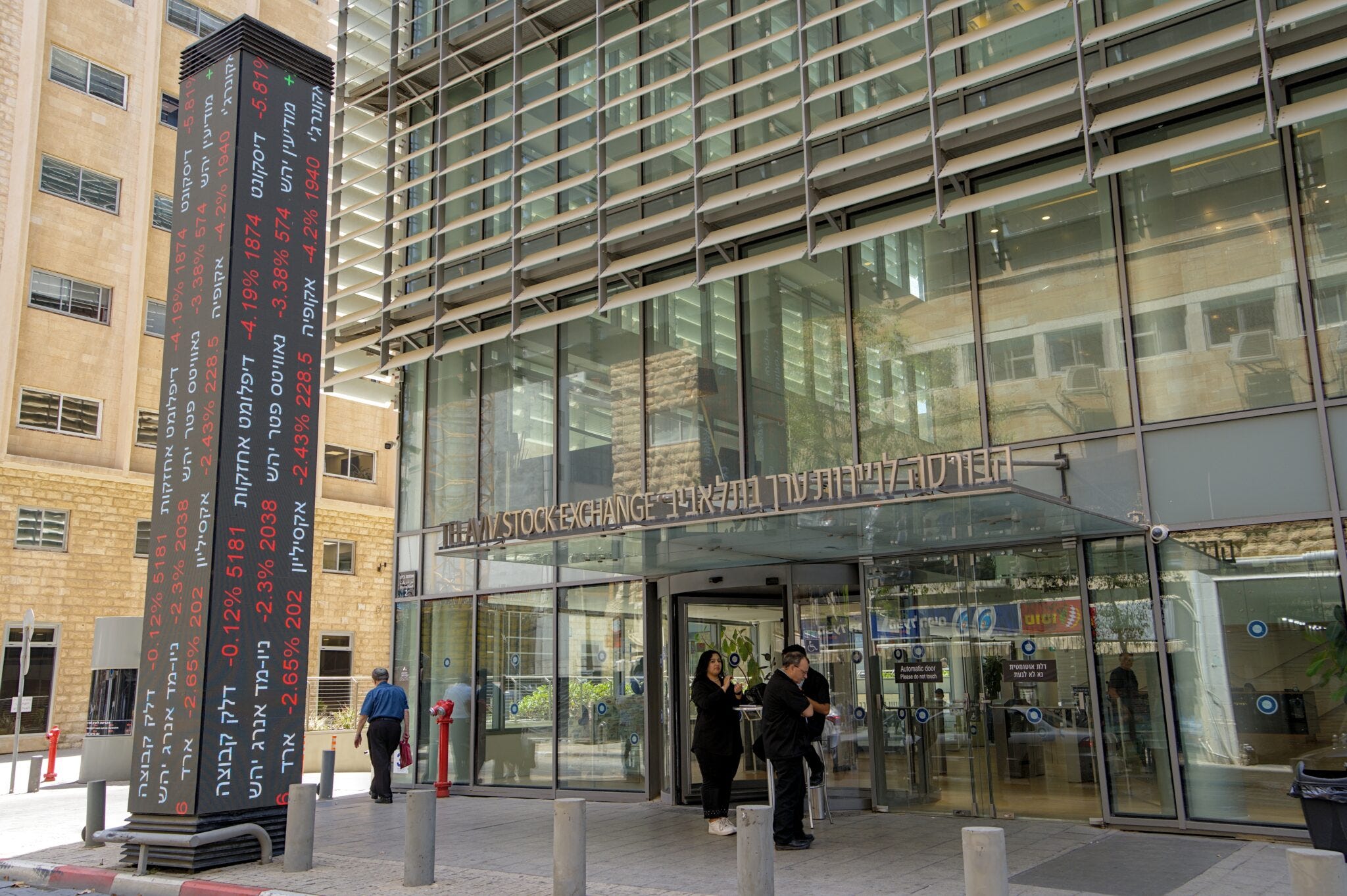
TASE-listed companies distributed a historic ₪40.8 billion in dividends in 2025, marking a nearly 30% surge from 2024 and a 50% jump from 2023. A decade-high 241 companies, representing 44.5% of all listed firms, issued payouts. The public captured a record 65% (₪26.5 billion) of the distributions, with the remaining 35% going to controlling shareholders.
Despite the nominal surge, the average dividend yield compressed slightly to 2.7% (down from 3.0% in 2024), diluted by a broader market rally that pushed the average TASE market cap to ₪1.5 trillion. The financial sector dominated the distributions, with banks accounting for one-third (₪13.4 billion) of the total.
Bank Leumi (TASE:LUMI) led with a record ₪3.9 billion payout, followed closely by Bank Hapoalim (TASE:POLI) at ₪3.5 billion. Non-bank heavyweights also capitalized on the liquidity wave, notably Delek Group (TASE:DLEKG) issuing ₪1 billion.
Gabay Group officially completed its initial public offering on the Tel Aviv Stock Exchange, listing at a post-money valuation of ₪875 million. The residential and commercial developer successfully raised ₪174 million from a syndicate of leading institutional investors in exchange for 20% of its shares.
Prior to the equity float, the company had already tapped the public debt markets, raising ₪545 million across two bond series. The firm currently manages a development pipeline of 25,000 housing units and holds over ₪1 billion in income-producing properties. Post-IPO, the Gabay family retains an 80% controlling stake.
TASE snapshot for Wednesday, March 11, 2026
TA-35 Index (TASE:TA35): 🟢 +0.57%
TA-90 (TASE:TA90): 🔴 -1.15%
TA-125 (TASE:TA125): 🟢 +0.21%
If you enjoyed this update, forward it on.
TV10 Global | Israel for Investors
Bringing you the top stories from the Israeli business community, by Israel’s only business and finance network.
Share your thoughts with us via: global@tv10.co.il or the Newsroom WhatsApp: +972-55-994-5851.
📧 Subscribe to this newsletter! And follow the daily conversation on 𝕏 @tv10global.
Pings available via WhatsApp Channel.
Disclaimer: This brief is for informational purposes only and does not constitute investment advice. All data current as of publication date.