

🍿 Get the Daily on Spotify, too
Quick takes:
Regulation: The Accountant General reactivates the state-backed cargo insurance program to guarantee maritime and air trade continuity; Tax Authority compensation funds deploy 30 specialized teams to handle damage claims arising from Operation Roaring Lion; Bank of Israel (BOI) mandates a major loan-deferral framework for households and small businesses impacted by Operation Roaring Lion.
Infrastructure: Israel shutters key natural gas reservoirs as a security precaution following the launch of Operation Roaring Lion.
Tech: Smart Shooter completes a ₪900 million IPO on the TASE.
Capital Markets: The TASE opens the trading week with a massive relief rally.
Editor’s Note
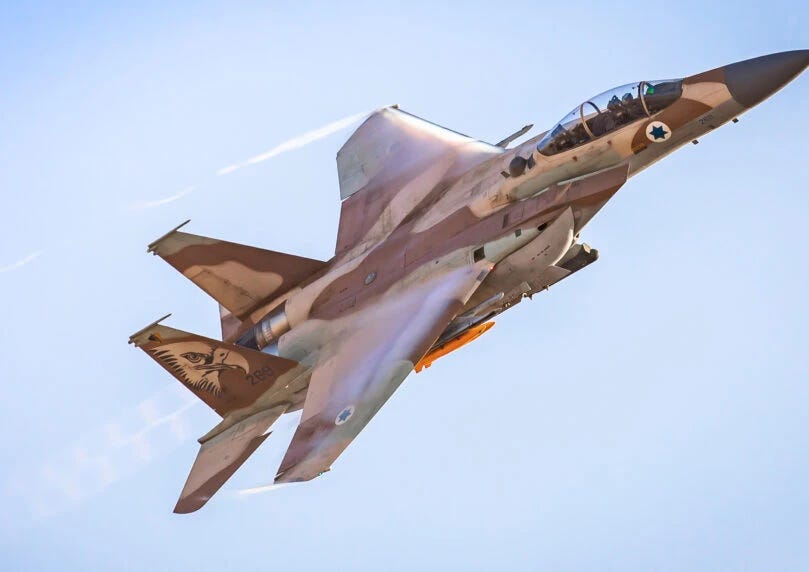
There is certain cold stillness that descends upon a market when contingency becomes kinetic. This morning, as we open the first trading week of our War Diary, that stillness is palpable. Operation Roaring Lion has transitioned from a strategic shadow to a reality that now governs every yield curve and supply chain in the Eastern Mediterranean.
For the investor, the fog of war is usually a signal to retreat. But in Israel, war is often the catalyst for institutional innovation. Today we see the state stepping in where private insurance fled, and a defense-tech firm reaching for public liquidity in the middle of a regional strike. We are no longer just tracking data points; we are documenting the resilience of a sovereign economy under the ultimate stress test.
Capital Markets
The Tel Aviv Stock Exchange opened today with sharp gains, a classic ‘uncertainty discount’ reversal following the dramatic escalation of Operation Roaring Lion. The TA-35 rose 4.61%, while the TA-90 surged 5.14%. The rally was led by the Insurance (+8%) and Financials (+6%) sectors, alongside Defense and Energy (+5.8%).
Notable individual movers included Navitas Petroleum (TASE:NVPT.W6), which soared 35.24%, and Delek Group (TASE:DLEKG), up 8.49%. Defense giants followed suit with Bet Shemesh Engines (TASE:BSEN) and Next Vision (TASE:NXSN) rising 10.11%, while Third Eye (TASE:THES) skyrocketed 23.66%. In the currency market, the Shekel showed significant strength, with the Dollar losing 0.33% to trade at ₪3.121.
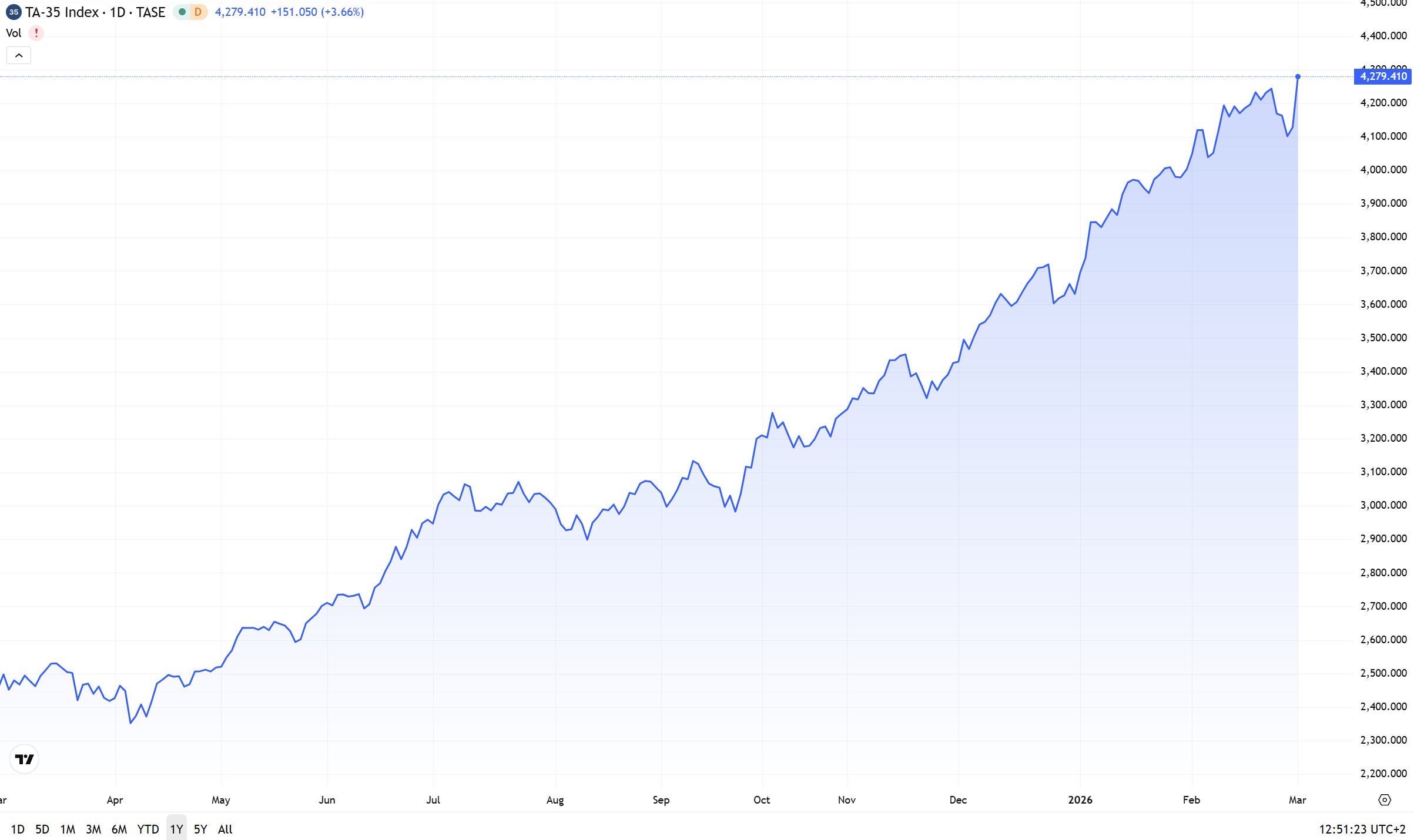
Our take: This is the Clarity Premium in full effect. It is remarkable to witness a profound market divergence: while U.S. and European markets are plunging as they price in global energy instability and supply chain contagion, the TASE is rallying. According to Or Poria, Chairman of Poria Finance, the dramatic elimination of the Iranian Supreme Leader is being viewed as a strategic pivot point that could collapse the regional risk premium. While the gas shutdown remains a tactical hurdle for energy players, the domestic market is betting on a regime instability scenario in Tehran that would fundamentally de-risk the Israeli long-term thesis. Local investors are essentially decoupling from global panic, focusing on the potential for a new, more stable regional architecture.
Regulation
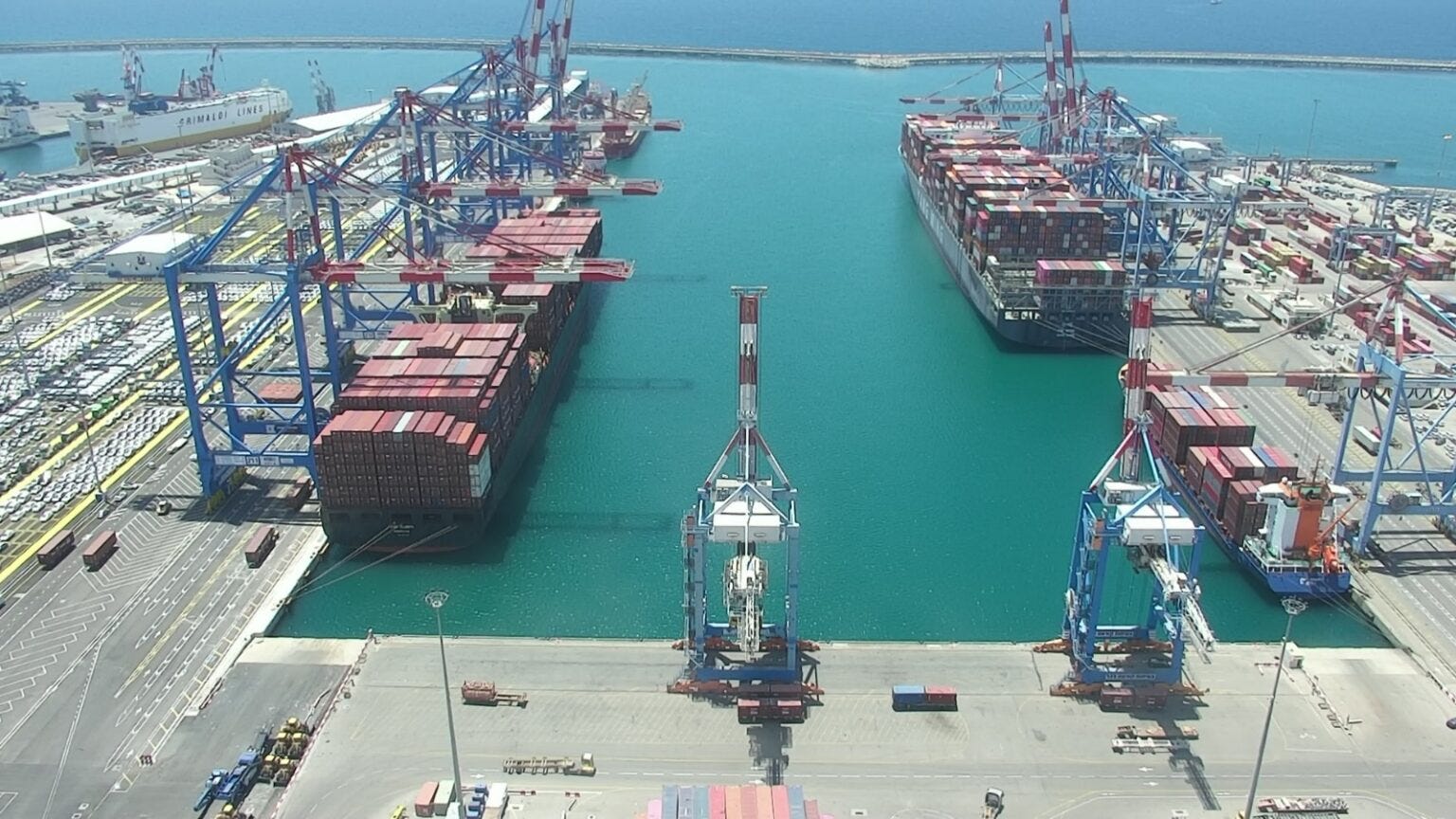
The Accountant General, Michal Abadi-Boiangiu, announced the return of the state-guaranteed cargo insurance program to protect maritime and air trade against war and terror risks. Valid through March 2026, the program provides a crucial backstop for importers and exporters after international insurers withdrew coverage following the commencement of Operation Roaring Lion.
To date, the fund has insured over $1.1 billion in cargo.
Simultaneously, the Israel Tax Authority has established a dedicated compensation fund for domestic property damage, already processing 655 claims, primarily in the Tel Aviv and Ashkelon sectors.
Our take: This is the sovereign backstop in action. By assuming the tail-risk that private insurance markets refuse to touch, the state is effectively subsidizing the continuity of the Israeli supply chain. For investors, this prevents a complete economic cardiac arrest, though the fiscal cost of these payouts and insurance guarantees will eventually weigh on the 2026 budget deficit.
The Israel Tax Authority has mobilized its Compensation Fund (Keren Pitzuim) to address domestic property damage. Directed by the Accountant General, specialized teams including engineers and appraisers are currently operating in the field.
As of this morning, 30 teams are active (22 in Central Israel, 8 in the North), processing 655 claims: 523 for structural damage, 64 for equipment, and 68 for vehicles. A fast-track portal has been opened for claims up to ₪30,000, allowing for approvals within 7 days without requiring an on-site appraiser.
Bank of Israel and Governor Prof. Amir Yaron announced a sweeping support framework for those impacted by the war. The plan includes a 3-month mortgage and loan deferral (interest-free and fee-free) for evacuated or injured households. Small businesses (with turnover up to ₪2 million) can defer loans for two months interest-free, while reservists receive a 2-month interest waiver on overdrafts up to ₪30,000.
Infrastructure

Israel has ordered the temporary shutdown of major natural gas fields as a preemptive security measure following the escalation of joint U.S.-Israeli operations in Iran.
While the Ministry of Energy remained vague on the full list, Energean Plc confirmed it suspended production at the Karish field. This move mirrors protocols from last year’s Operation Am KeLavi and places immediate pressure on regional energy exports.
The Leviathan and Tamar fields, operated by Chevron, are critical lifelines for Egypt, which relies on Israeli gas to meet its internal cooling and industrial needs.
Our take: The energy shutdown highlights the fragility of the hub. While Israel aspires to be a regional energy anchor, the immediate suspension of exports to Cairo proves that geopolitical volatility remains the primary discount factor for Eastern Mediterranean energy plays. Expect a spike in regional LNG spot prices as Cairo is forced to seek alternative, more expensive cargoes.
Technology
Smart Shooter completed its Initial Public Offering on the TASE today, reaching a post-money valuation of ₪900 million.
The company raised ₪200 million from institutional investors, alongside a ₪60 million secondary sale. Total demand reached ₪472.5 million, reflecting a 2.3x oversubscription.
The company’s SMASH technology uses AI-driven computer vision to ensure precision fire for small arms, a capability seeing massive tailwinds due to the global surge in drone warfare. Smart Shooter projects 2025 revenues of $36.5 million (a 49% YoY increase) with EBITDA jumping 500% to roughly $7 million.
Our take: Smart Shooter represents the democratization of precision. As militaries shift toward cost-effective solutions for neutralizing low-cost threats like drones, the successful IPO in the midst of a regional conflict underscores the TASE’s role as a primary liquidity venue for battle-tested defense tech.
TASE snapshot for Monday, March 2, 2026
TA-35 Index (TASE:TA35): 🟢 +4.61%
TA-90 (TASE:TA90): 🟢+5.14%
TA-125 (TASE:TA125): 🟢 +4.75%
If you enjoyed this update, forward it on.
TV10 Global | Israel for Investors
Bringing you the top stories from the Israeli business community, by Israel’s only business and finance network.
Share your thoughts with us via: global@tv10.co.il or the Newsroom WhatsApp: +972-55-994-5851.
📧 Subscribe to this newsletter! And follow the daily conversation on 𝕏 @tv10global.
Pings available via WhatsApp Channel.
Disclaimer: This brief is for informational purposes only and does not constitute investment advice. All data current as of publication date.