

🍿 Get the Daily on Spotify, too
Quick takes:
Global Energy: Global oil prices surge 6% and diesel 14% following the Iranian IRGC’s declaration of a de-facto closure of the Strait of Hormuz; Qatar’s Ras Laffan LNG plant shuts down following an Iranian drone strike.
Regulation: Finance Committee initiates 2026 budget debates targeting a 3.9% deficit ceiling; MoF maintains a 5.2% GDP growth forecast for the year; Opposition MKs estimate war costs at ₪2–2.5 billion per day; Budget Director signals that the current defense budget provides some coverage for long-term procurement.
Tech: Israeli cyber startup Fig Security emerges from stealth with $38 million in funding.
Editor’s Note
The strategic landscape shifted again today. While we have spent the last 72 hours tracking the domestic liquidity fortress, the front line has moved to the Strait of Hormuz. The de facto closure of this global artery has turned a regional preemptive strike into a systemic shock for global energy markets.
Domestically, the Knesset’s Finance Committee has begun the thankless task of trying to anchor a wartime budget. There is a palpable tension in the air: the Treasury is fighting to maintain its pre-war growth forecasts to project strength, while the military reality on the ground, with Operation Roaring Lion entering a high-intensity phase, demands an immediate, massive expansion of fiscal boundaries. We are watching a high-stakes balancing act between fiscal credibility and the overwhelming cost of regional realignment.
Global Energy

The global energy market has entered a volatile contagion phase. The Strait of Hormuz, a chokepoint for 15% of global oil and 20% of LNG, is now de facto shuttered to commercial traffic following an IRGC declaration.
This systemic blockade was compounded by retaliatory strikes against Saudi Arabia’s Ras Tanura refinery, one of the world’s largest, which sustained damage from drone debris.
The crisis intensified this afternoon as QatarEnergy declared Force Majeure at its Ras Laffan LNG terminal, the world’s largest export hub. The facility, which supplies nearly 20% of the global LNG market, was forced offline following a direct Iranian drone strike. The market reaction was violent as European gas futures skyrocketed 54% to €44.51/MWh, their highest level since March 2025.
Further south, the United Arab Emirates reported a drone-strike-induced fire at the Port of Fujairah, the world’s third-largest bunkering hub. While the blaze in the oil storage zone is reportedly under control, the psychological blow sent Brent Crude surging 8.1%. Global storage giants Vopak and VTTI have already suspended operations and restricted site access as a precaution.
Domestically, Energean Plc (TASE:ENOG) remains under pressure following the government-ordered suspension of the Karish field. While the Leviathan and Tamar fields operated by Chevron are critical for Egyptian stability, the closure of Hormuz is now the primary driver of global diesel prices, which have jumped 14%.
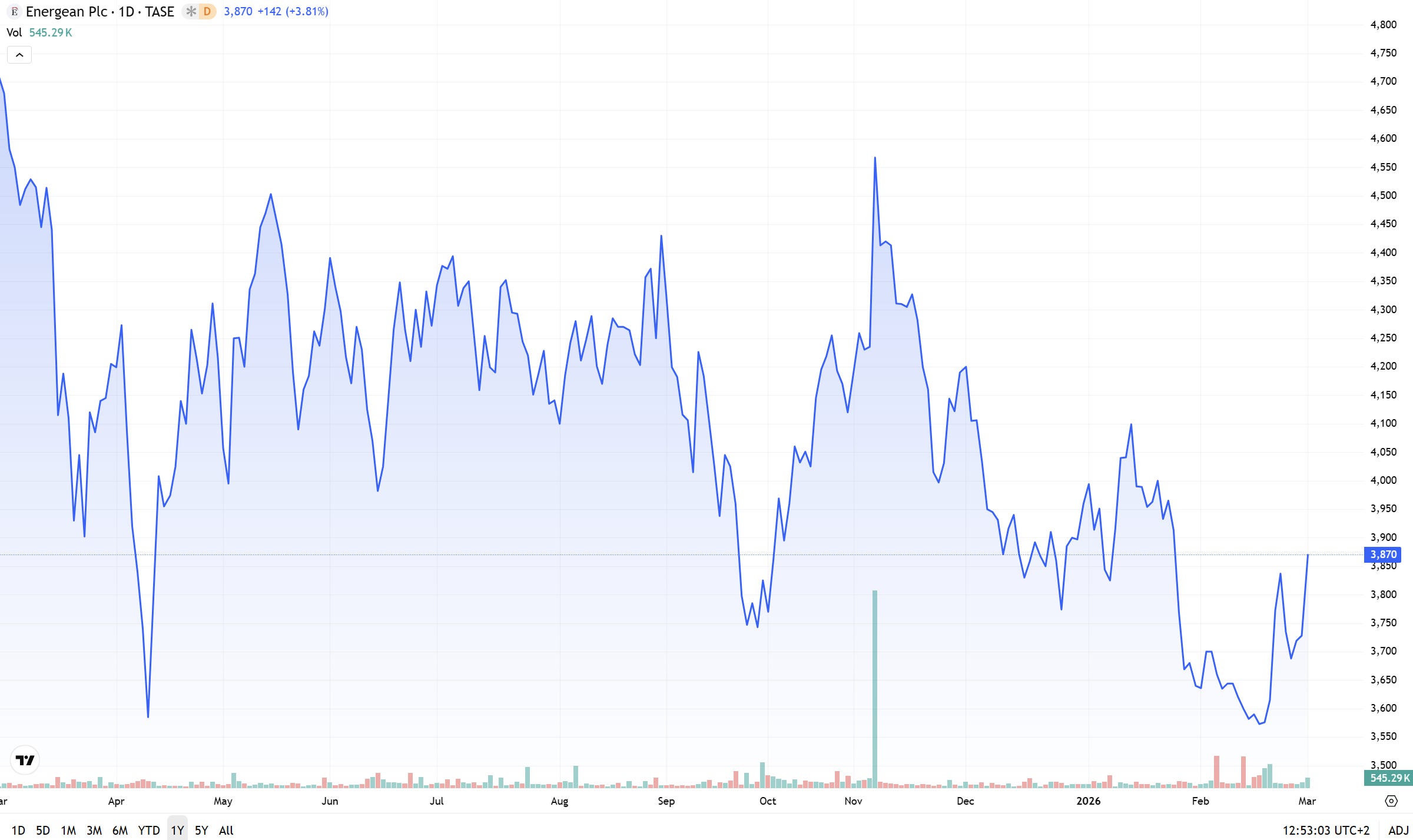
Our take: We are moving from a supply squeeze to a total logistical blockade. While Israel’s tactical reservoir shutdowns were expected, the neutralization of Fujairah and Ras Laffan turns a regional preemptive strike into a global economic crisis.
The 14% jump in diesel prices will hit Israeli logistics immediately. If Gulf infrastructure remains in the crosshairs, the regional risk premium will decouple from standard fundamentals, turning energy into a pure volatility play for the foreseeable future.
Regulation

The Finance Committee, chaired by MK Hanoch Milwidsky, began deliberations on the 2026 Deficit Reduction Law. The Ministry of Finance (MoF) is attempting to hold its proposed ₪659.9 billion spending limit, an 11.3% increase over 2025. The strategic goal remains stabilizing the debt-to-GDP ratio at 68.5%, with a deficit glide path aiming for 2.4% by 2029
However, political friction is mounting. MK Vladimir Beliak characterized the proposal as detached from reality, estimating the daily cost of Operation Roaring Lion at up to ₪2.5 billion.
Budget Director Mahran Frozenfar countered that while current military structures offer some fiscal shock absorption for long-term procurement, the MoF will only map out precise adjustments once the conflict’s duration becomes clearer.
Our take: By sticking to pre-war projections of 5.2% growth, the Treasury is betting on a V-shaped recovery that assumes the kinetic phase of Roaring Lion concludes within a two-week window. For investors, the real metric to watch is the ₪575 billion State revenue forecast; any prolonged disruption to the labor market will force a messy mid-year budget expansion, likely pressuring Israel’s sovereign credit rating.
Technology

Fig Security announced $38 million in fundraising across their Seed and Series A rounds led by Team8 and Ten Eleven Ventures. Investors include heavyweights like former Splunk CEO Doug Merritt and former Palo Alto Networks CMO Rene Bonvanie.
The startup, founded by veterans of 8200 and Google, targets ‘silent failures,’ minor data shifts that blind existing security tools.
Our take: Fig Security is seeking to solve the ‘observability gap’ in cybersecurity. In a wartime environment where cyberattacks are as frequent as missile launches, ensuring that security infrastructure isn’t silently failing is a critical mission.
No TASE snapshot for Tuesday, March 3, 2026
The Tel Aviv Stock Exchange is closed today in a planned closure in observance of the Purim holiday.
If you enjoyed this update, forward it on.
TV10 Global | Israel for Investors
Bringing you the top stories from the Israeli business community, by Israel’s only business and finance network.
Share your thoughts with us via: global@tv10.co.il or the Newsroom WhatsApp: +972-55-994-5851.
📧 Subscribe to this newsletter! And follow the daily conversation on 𝕏 @tv10global.
Pings available via WhatsApp Channel.
Disclaimer: This brief is for informational purposes only and does not constitute investment advice. All data current as of publication date.