

Editor’s note:
Editor’s note: The global financial press is currently transfixed by the grand theater of macro diplomacy. The signing of a memorandum of understanding between U.S. President Donald Trump and Iranian President Masoud Pezeshkian, paired with crude oil prices plunging toward $75 a barrel, has been widely broadcast as a paradigm-shifting de-escalation for the Middle East. Yet beneath this veneer of geopolitical euphoria, the Tel Aviv Stock Exchange is quietly flashing a dangerous, bearish signal that mainstream analysts seem to be trying to ignore.
The sharp decline across domestic broad indices reveals a profound structural mispricing that has finally come to light. For months, local market participants operated under a collective euphoria, aggressively betting that high-intensity operations under Operation Roaring Lion would achieve a definitive, terminal resolution to the regional threat matrix, effectively eliminating kinetic risk from the long-term pricing model.
The Washington-Tehran accord has brutally shattered that illusion, proving that a diplomatic freeze does not equal absolute deterrence. By locking in a status quo that leaves hostile proxy architectures entirely intact, the deal keeps a post-war peace dividend off the table, turning the geopolitical risk premium on Israeli assets back on.
I feel it is important to avoid the editorial trap of blaming the Israeli consumer for the broader domestic economic stagnation that will exacerbate this premium. The consumer is a rational economic actor, trapped by a protectionist trade regime and a lack of true asset portability across retail and financial sectors.
Instead, the culpability lies with a succession of governments that have substituted deep structural deregulation with performative interventions. In this week’s deep dive, we rip away the geopolitical noise to explore the quiet bear awakening on the TASE, the institutional pullback from leading tech champions, and the structural trade barriers driving a profound disconnect between market valuations and economic reality.
— Sophia Tupolev, TV10 Global Editor
TASE weekly snapshot
The Tel Aviv Stock Exchange closed the week on a positive note.
TA-35 Index (TASE:TA35): 🟢 +1.77%
TA-90 (TASE:TA90): 🟢 +0.49%
TA-125 (TASE:TA125): 🟢 +1.43%
The return of the geopolitical risk premium
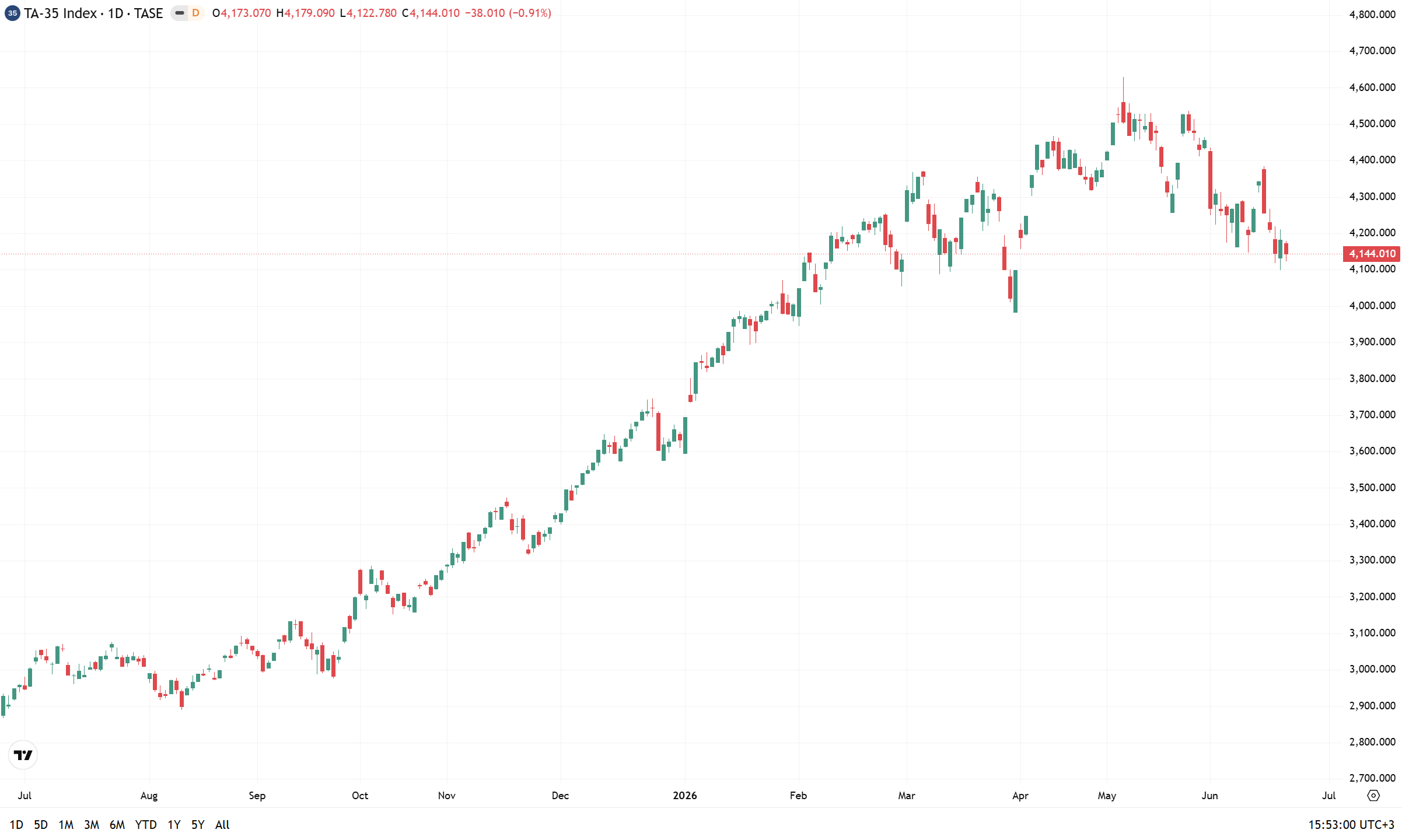
Last week’s sharp retreat across the TASE flagship indices unmasked the fragility of the domestic market’s recent euphoria. For months, local traders bet heavily that kinetic risk would be thoroughly eliminated, unlocking unprecedented long-term valuations. The Trump-Pezeshkian memorandum of understanding abruptly shattered this premise. Institutional capital instantly realized that diplomatic containment locks in an unresolved proxy threat matrix, meaning local corporate operations must absorb massive insurance premiums, supply chain friction, and heightened security overhead. Far from a stabilizing mechanism, the deal has effectively re-codified the geopolitical risk premium as a fixed structural tax on Israeli equities.
This newly reactivated risk premium is colliding directly with a punishing global monetary contagion.
In his inaugural FOMC press conference as Federal Reserve Chairman, Kevin Warsh delivered an unexpectedly hawkish hold, leaving borrowing costs within a restrictive 3.5% to 3.75% range. Warsh explicitly challenged traditional economic models, warning that persistent inflation, partially born from the recent war, will be fought by shrinking the Fed’s bloated balance sheet and potentially hiking rates as early as July.
This hawkish stance ignited a violent sell-off in short-term US paper, driving two-year Treasury yields to a multi-year high of 4.22%. As global liquidity migrates rapidly toward risk-free American sovereign debt, the TASE is being systematically bled of the capital needed to sustain overextended valuations, plunging the TA-Cleantech index by 2.5% and the TA-Real Estate index by 1.97%.
Insider capital flight
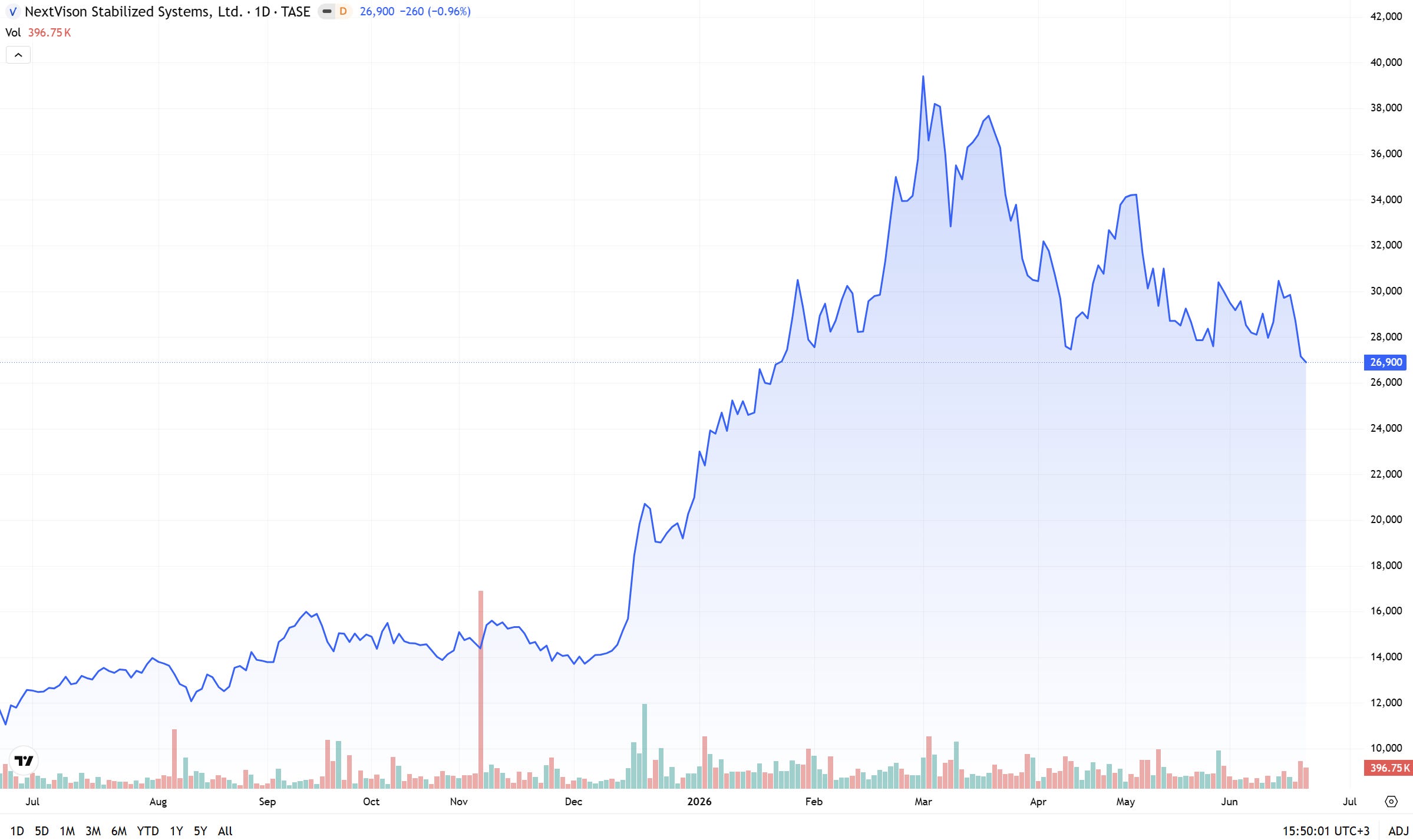
Recognizing that a permanent kinetic tax paired with a hawkish Federal Reserve will aggressively compress corporate margins, corporate insiders are quietly moving toward the exits before the bear fully awakens. This reality materialized in a massive $200 million (₪588 million) off-market block sale by top executives at Next Vision (TASE:NXSN).
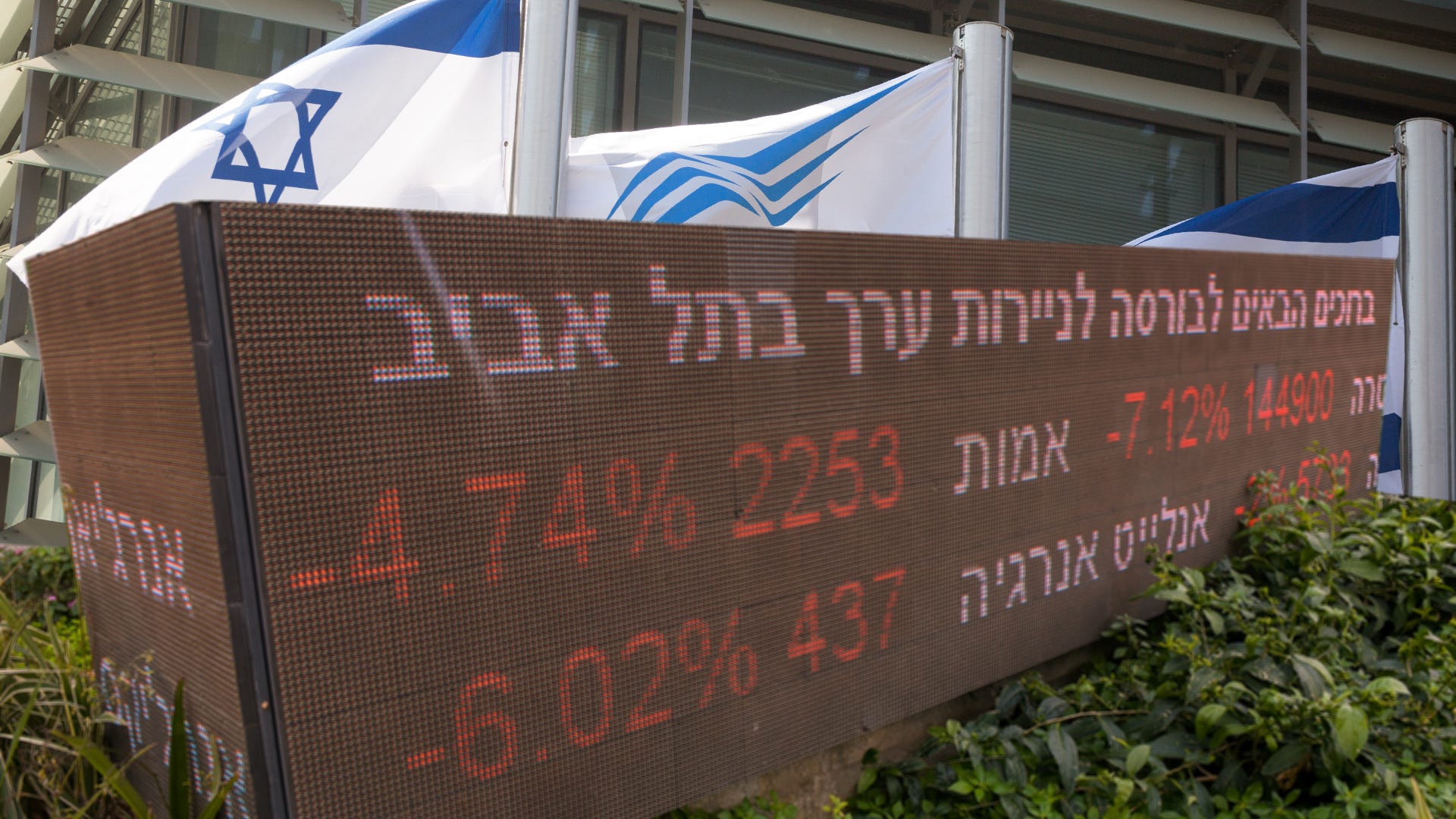
By liquidating 2.2% of the company’s total outstanding share capital to leading global and domestic institutional investors, management triggered an immediate 4.74% drop in the stock price. While corporate public relations spun this as an orderly institutional distribution, the macroeconomic might be signaling that domestic cash flow generation has hit a definitive ceiling.
This insider equity liquidation triggered an immediate contagion across highly leveraged and defensive domestic sectors. The TA-Insurance and Financial Services index declined 2.51%, while Gilat Telecom (TASE:GILT) plunged 4.44% and Electra Real Estate (TASE:ELCRE) slid 2.18%.
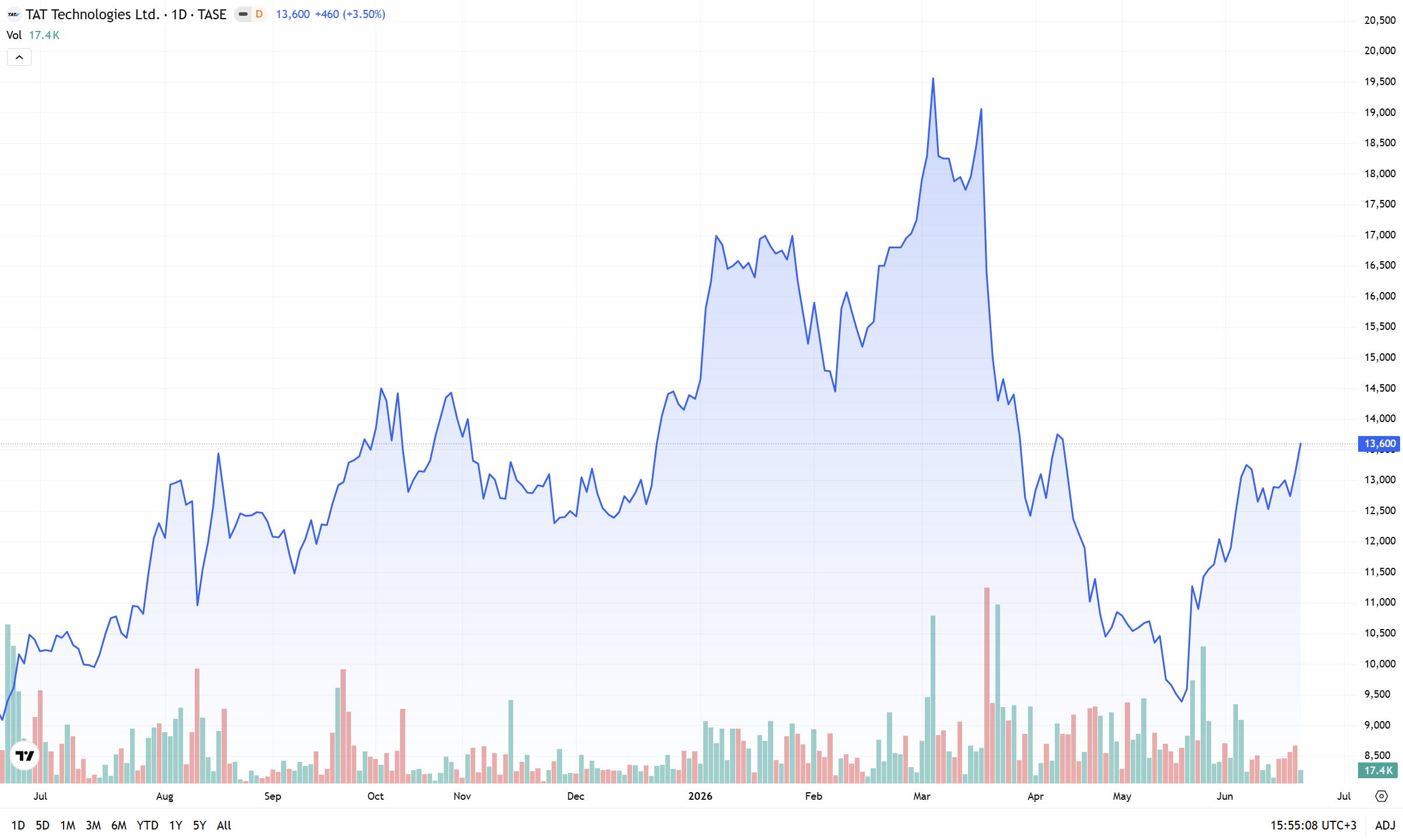
The market seems to be experiencing a capital reallocation; the rare pockets of green, such as TAT Technologies (TASE:TATT) gaining 3.69% and R.G.A. (TASE:RGAS) rising 1.4% on a new ₪79 million municipal sanitation contract, prove that institutional investors are abandoning broad-market growth assumptions. Instead, capital is retreating into hyper-insulated niches anchored by rigid state public infrastructure spending or global aerospace pipelines. For the broader market, the lack of asset portability and rising systemic costs mean that general equity growth could potentially hit a dead end.
Asymmetric price transmission

This systemic margin compression and equity decay are directly mirrored in the real economy, as highlighted by this week’s emergency Knesset Economics Committee session. Lawmakers gathered to grill regulators over why the shekel’s climb to a multi-year high of ₪2.94 per dollar has failed to lower consumer food and pharma prices.
Data compiled by the Knesset Research and Information Center (Hamam”m) exposed a “surprising” discrepancy: while domestic real food prices climbed by 0.2% between August 2025 and April 2026, the European Union recorded a 1.1% decline. Even more damning, while global food commodities fell by 3.6% from 2022 to late 2025, Israel’s consumer price index skyrocketed by 18.8%. In economics, this is textbook asymmetric price transmission, the ‘rockets and feathers effect’, where retail prices shoot up instantly during cost spikes but drift down lazily when inputs fall.
Yet, the corporate and political responses to this phenomenon look like retail theater. Domestically insulated manufacturers and business groups claim that local inputs, including electricity soaring 62%, water by 53%, and minimum wage obligations by 10%, preclude price cuts.
Meanwhile, government bodies stage performative interventions, bragging about imposing a ₪111 million fine on Strauss or blocking isolated mergers. These actions are completely hollow because they leave the root policy failures untouched. The cartel pricing power wielded by the three conglomerates controlling over 70% of the market share across 30 out of 38 major food categories is a direct product of state-enforced barriers: prohibitive kashrut compliance economics, strict capital controls, and rigid import quotas that legally insulate domestic distributors. The consumer is a rational actor; they do not pay premium prices due to compliance or complacency, but because state policy explicitly denies them market alternatives.
The structural fix to dissolve this cartel pricing power and arrest the widening bearish trend across the TASE might be radical, unmitigated deregulation. The Ministry of Economy should transition away from performative toothless warnings and execute a complete legislative decoupling of distribution systems from exclusive importers.
Furthermore, Israel must aggressively implement a comprehensive regulatory alignment, accepting European product standards without secondary domestic testing bureaucracies. Opening national borders to raw, unmitigated parallel imports is the only mechanism that will force local conglomerates to compress their artificial margins. Until these protectionist walls are dismantled, domestic corporate assets will remain choked by local cost structures, making them increasingly uncompetitive to global investors.
That’s our letter, folks. If you enjoyed this Weekly, forward it on.

The English TV10 newsletter is edited by Sophia Tupolev. We love to hear from you.
TV10 Global | Israel for Investors
Now in English: Bringing you the top stories from the Israeli business community, by Israel’s only business and finance network.
Please share your thoughts with us via: global@tv10.co.il or the Newsroom WhatsApp: +972-55-994-5851.
📧 Subscribe to this newsletter! And follow the daily conversation on 𝕏 @tv10global.
Pings with new editions are also available via our WhatsApp Channel.
Disclaimer: This brief is for informational purposes only and does not constitute investment advice. All data is current as of publication date.