


Editor’s note:
An economics editor walks into a Yeshiva with a bunch of businesspeople…. Last week, I led a delegation of 15 secular investors to one of Jerusalem’s largest Yeshivas - 1,500 full-time Torah scholars. While we’d come to learn together, the discussion quickly turned to the stock market. I shouldn’t have been surprised. Many of these young men’s careers revolve around the markets, out-earning the average Israeli. Yet, officially, they’re ‘unemployed,’ and pilloried in parts of Israeli society for ‘not working,’ This is just one example of how the definition of employment hasn’t caught up with the economic reality in Israel - and how little we know about the economic realities of the communities just next door.
— Eran Bar Tal, Editor-in-Chief, TV10
The quick read:
Two big stories to know in the Israeli economy - the credit rating and the interest rate cut. Despite two years of continuous conflict, S&P maintained Israel’s credit rating (A/A-1) with an upgraded outlook from negative to stable.
On November 24th, 2025, the Bank of Israel announced an interest rate cut for the first time in nearly two years - down 25 basis points to 4.25%. This is your blinking indicator on how well the Israeli economy is doing - let’s unpack it.

In its announcement, BoI cited economic activity recovering sharply in Q3. Here’s what they mean.
The Shekel is strengthening, the labor market is tightening, inflation is coming under control at 2.5%, so prices are rising. But rising within the BoI’s target ‘healthy’ range of 1-3%. Consumer spending was strong in October, and home prices have fallen for 7 consecutive months. Tel Aviv real estate, once among the world’s most expensive, dropped as much as 10%.
The Tel Aviv Stock Exchange was up for the end of the week, with Israel’s leading index (TASE:TA35) up 0.93%, and Israel’s midcap index (TASE:TA90) up 1.8%. Bank Leumi (TASE:LUMI) became the first Israeli bank to cross a ₪100B market cap, doubling its stock price since October Seventh. Major exits in tech- Google cleared regulatory hurdles for its $32B Wiz acquisition, Carbyne sold for $625M in an all-cash deal, and Locusview is being acquired for $525M.
The government is moving aggressively on structural reforms that affect the economy. Finance Minister Smotrich plans to triple cheese import quotas to break a Tnuva-Strauss duopoly and approved fast-track urban renewal for war-damaged zones. All this as Israel waits for the 2026 budget to be approved.
Meanwhile the bombshell Histadrut corruption scandal has expanded to over 300 individuals across Israel’s largest labor union, potentially affecting TASE public companies El Al (TASE:ELAL) and Israel Railways (TASE:RAIL).
International relations have further ability to contribute to recovery. Kazakhstan joined the Abraham Accords, while Saudi Arabia is still sitting it out, making platitudes about “two states.” Meanwhile, India and Israel will begin negotiating a Free Trade Agreement, and Spanish SMBs inked deals with our tech ecosystem.
All of this together paints an encouraging picture - but there’s more to the story.
Onwards.

Real estate prices plunge in central Israel
Israeli real estate, particularly in Tel Aviv, is experiencing its first buyer’s market in years. Tel Aviv and the surrounding metro region (Gush Dan) saw prices drop 10%. Properties that once sold within weeks sat for months. Driving this:
Mortgage originations are down as uncertainty keeps potential buyers on the sidelines;
Foreign construction workers stopped arriving in Israel, impacting timelines;
82,000+ Israelis left the country, many of which, high earners who drive luxury property demand;
Investor activity slowed significantly.
Our take: For investors with capital and longer time horizons, November presented Tel Aviv entry points unavailable during 2019-2023. Distressed sellers and motivated developers created deals that seemed impossible two years ago. If emigration accelerates or security deteriorates further, prices could soften further.
Israel inks deals with Spain’s leading SMB group
✉️ Notes by Nikolay Taleisnik, Head of TV10 Foreign Desk

International business interest in Israel is heating up. This week, a delegation from CONPYMES - Spain’s largest confederation representing more than 2 million small and medium-sized businesses - arrived in Israel for a series of high-level meetings. The group signed two formal cooperation agreements to give Spanish SMBs direct access to Israel’s advanced tech ecosystem.
Our take: The mission’s timing is especially notable given that Spain is currently governed by a far-left socialist government that has taken an explicitly anti-Israel stance in recent months. Despite the political rhetoric, Spain’s business community operates in a different reality: SMBs increasingly view Israel as an indispensable global innovation hub. While the government pursues a radical ideological agenda, the private sector acts out of economic pragmatism - strengthening ties with Israel because of its technological leadership and the competitive advantages it offers.

Earnings season, peak foreign investor confidence
✉️ Notes by Moshe Maimon, Head of TV10 Capital Markets
Foreign ownership of TASE stocks hit a record 47%, suggesting international investors remain confident in Israeli assets despite headline security risks.
The trading week was influenced by several factors:
The fact that the ceasefire is holding in Gaza. Though it appears fragile, with some combat at the Yellow Line as Israeli troops respond to violations by Hamas terrorists, it is (broadly) in place. As many IDF reservists return to their jobs, the economy is recovering rapidly.
The interest rate cut. The Bank of Israel lowered the interest rate by 0.25% on Monday this week. Locally, investors met the announcement with slight disappointment. This rate cut was long anticipated and could be described as absolutely necessary, while BoI cast doubt on there being a “path of rate cuts” in the coming months.
Q3 earnings announcements. Despite this week’s strong financial reports across the insurance industry, many insurance stocks experienced a significant decline this week. They weren’t helped by regulators, who announced a requirement to reduce car insurance premiums. More broadly, sectors like retail, real estate, and the financial sector reported positive data.
This was a positive week for the local capital market, which also got a tailwind from the gains in the US capital market.
Who moved their cheese? Dairy reforms spark controversy
Israeli cheese prices run 50% above the European average, while Tnuva and Strauss (TASE:STRS) have been formally designated as monopolies, controlling the market for decades.
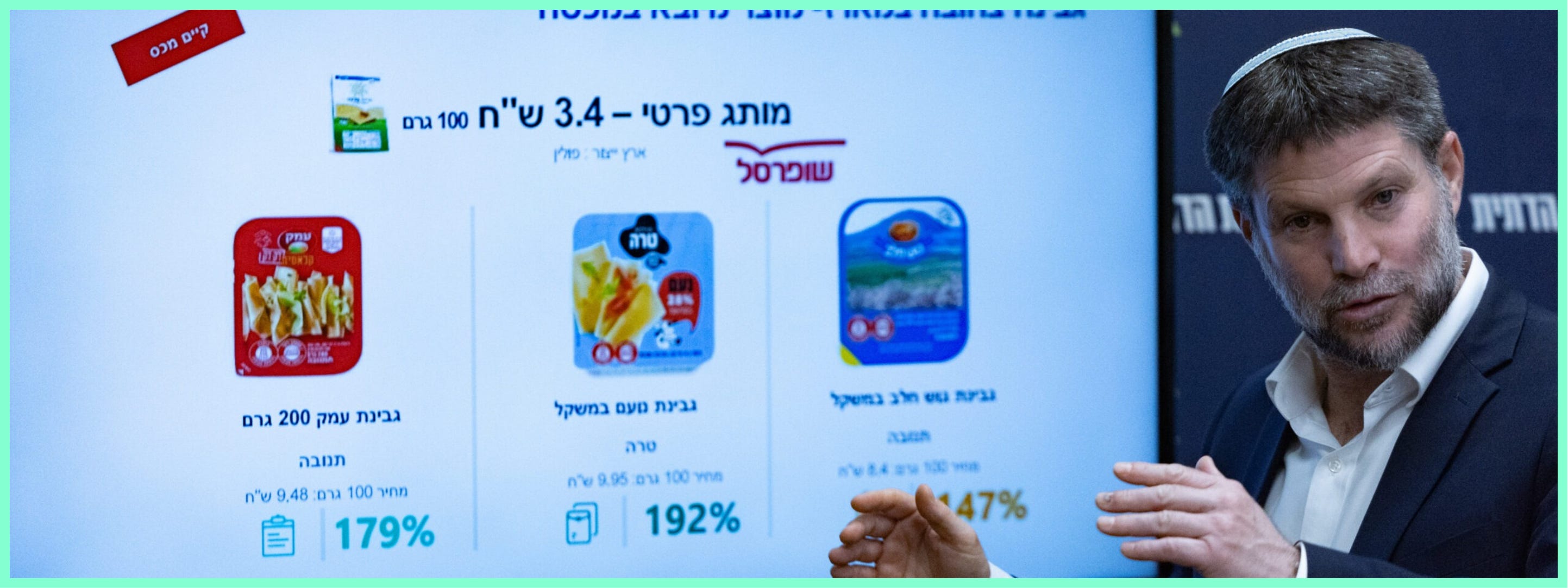
What’s in play: In well-publicized dairy industry reforms, Finance Minister Smotrich announced a 70% expansion of duty-free cheese import quotas today, from 11,500 tons annually to 19,500 tons starting January 2026. The actual allocation will triple from 6,500 to ~20,000 tons once previously unallocated quotas are distributed.
Our take? This is a measured opening, not full liberalization. We’re watching for food retail margins to compress, dairy producers (especially smaller border farms) and their revenues to face pressure, and import/distribution companies (potentially, Turkey) capturing new market share.
The conversation in Israel- reform architects cite their projections of up to 15% price cuts for consumers. Yet polls show the majority of Israelis, 72%, don’t support the reform.

₪1 billion in new public investments in Negev region
The Israeli government approved ₪1 billion over 2025-2027 for Be’er Sheva and Negev development, focusing on economic growth initiatives, transportation infrastructure, quality of life improvements, education, and human capital.
Corruption: potential impact of a massive Labor Union scandal on state-adjacent companies
This is the scandal that dominated November headlines. The influential Chairman of Israel’s largest labor union (The Histadrut), Arnon Bar-David, remained in custody throughout the month. Bar-David is a longtime civil servant. Over 300 individuals are now implicated in bribery, fraud, breach of trust, money laundering, and tax offenses.

What happened: Police suspect the Histadrut operated a systematic scheme to bypass competitive tenders, funneling contracts to connected entities. An insurance agent is accused of providing thousands of shekels in loans, flights, and luxury restaurant benefits to Bar-David in exchange for union influence.
Named entities: El Al (TA: ELAL) and Israel Railways (TA: RAIL) are involved in the investigation, suggesting the network runs deep into state-adjacent, public companies.
Our take: minimal direct effect on stock prices so far. But if senior executives at these entities are formally implicated, expect governance concerns to weigh on valuations. The broader question: were any other state-linked organizations involved in similar schemes?
Tech corner: Israeli companies at nexus of global demand
Last week, Israeli energy infrastructure startup Locusview was snapped up by Itron (NASDAQ: ITRI) for $525M, underscoring global demand for grid-modernization and operational infrastructure software, fields where Israeli engineering continues to excel.
“Beyond software, global demand is moving toward energy systems, industrial intelligence, and deep infrastructure technologies,” said Moran Chamsi, Managing Partner at Amplefields Investments. “Israeli companies are positioned right at that intersection. If this continues, 2026 could be the year a new generation of Israeli scale-ups emerges from areas that were traditionally under the radar, but are now essential to the global economy.”
Behind closed doors, increased movement around applied AI and cyber: several early-stage rounds closed quietly, multinationals deepened scouting processes for Israeli dual-use technologies, and international chipmakers continued evaluating expansion footprints in northern and central Israel. These developments point to steady confidence in Israel’s long-term role as a global R&D hub, especially in the infrastructure layer.
The labor market paradox in Israel
✉️ Notes by Eran Bar Tal, Editor-in-Chief, TV10
Israel’s official unemployment rate (3%) is misleading. Young Israelis are leaving traditional employment - but they’re not unemployed. They’re investors. October 2025 employment data (released in November) points to this paradox.
Taking a longer view (2014-2025), youth labor force participation (under 25’s) has plummeted from 80% to 68%, while older workers (50+) are increasing their participation rate.
This is a long-term structural trend, not related to COVID or the war. Today, a larger proportion of wealth comes from capital gains, not salaries. Young people increasingly see investing as primary income, not traditional employment - and seek to make informed decisions with local data;
And although IDF reserve duty absences accounted for 6% of the workforce, employment still grew (total employed: Up 4.5% in October vs. September 2024);
Job vacancies increased across all sectors, with the sharpest rises in hospitality, food service, commerce, and construction.
Finally, consumer spending stayed strong, with credit card spending in October at approximately ₪46 billion. This represents robust activity given the security situation.
Our take: household balance sheets remain healthy. The combination of low unemployment, elevated wages in key sectors, and two years of forced domestic spending (reduced international travel) has kept demand strong, domestically.
December watch list
Effects of the Bank of Israel interest rate cut on Nov. 24, 2025
More earnings and guidance for 2026
Real estate data (more deals to be had in the Israeli market?)
Defense export numbers for Q4
Tech funding data for full-year 2025
Labor union investigation - executive indictments?


TV10 Global | Israel for Investors
Bringing you the top stories from the Israeli business community, by Israel’s only business and finance network. Share your thoughts with us via: global@tv10.co.il
📧 Subscribe |📱 Follow the daily conversation on 𝕏 @tv10global
Disclaimer: This brief is for informational purposes only and does not constitute investment advice. All data is current as of publication date.