
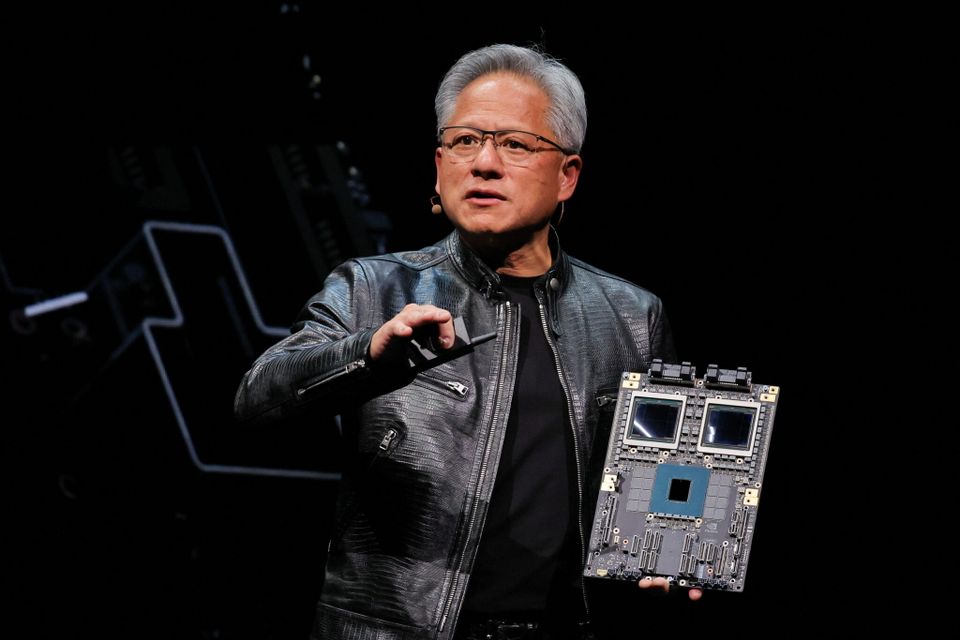
The departure of Jensen Huang, Nvidia’s founder and CEO, could be much more than a personnel change at the top of the chip giant.
For Israel, which in recent years has become one of the company’s strategic development hubs, the development raises questions about continued investment, the expansion of operations and the construction of one of the largest tech projects in the country’s history.
Huang was not only the man who led Nvidia to become one of the most important companies in the technology world, but also one of the most prominent supporters of the company’s operations in Israel. Under his leadership, the local operation grew from a small development unit into a strategic center responsible for developing the company’s core technologies.
Now, with Huang stepping down immediately, the company’s chief financial officer, Colette Kress, has been appointed interim CEO, and the board is expected to search for a permanent replacement from among internal and external candidates. The question is whether the new management will continue to view Israel as a strategic asset to the same extent.
Israel Is Not Just Another Nvidia Development Center
The relationship between Nvidia and Israel strengthened significantly following the acquisition of Israel’s Mellanox in 2019, in a deal valued at about $6.9 billion. The acquisition brought the company expertise in communications between chips and computing systems, which has since become a central part of artificial intelligence infrastructure.
Nvidia currently employs about 6,000 people in Israel, and its development centers operate in Yokneam, Tel Aviv, Jerusalem, Ra’anana and Beersheba, among other locations. The local operation is not limited to developing complementary products: Teams in Israel are involved in developing communications technologies, networking chips, systems that connect processors and infrastructure that enables data centers to operate AI systems on a massive scale.
Sales from Nvidia’s Israeli operations reached about $17.5 billion in the second quarter of 2026, about 18% of the company’s worldwide sales. The figure illustrates the business significance of the local operation, although Nvidia does not report Israel as a separate revenue segment.
In other words, Israel is not merely a place where Nvidia employs engineers because of its high-quality workforce. Some of the key technologies that enable the company to lead the AI revolution are developed here.
The Multibillion-Shekel Project: Is the Kiryat Tivon Campus at Risk?
One of the clearest expressions of Huang’s commitment to Israel is the plan to build a giant campus in Kiryat Tivon that would be Nvidia’s second-largest development center worldwide, after its headquarters in Santa Clara, California.
The project is expected to cover about 90 dunams, with about 160,000 square meters of built space, and accommodate up to 10,000 employees. The investment is estimated at billions of shekels, and the campus is planned to include work complexes, a park, cafes, restaurants and shared spaces.
The company said construction is expected to begin in 2027, with initial occupancy planned for 2031. The land has already been purchased from the Israel Land Authority for about NIS 90 million, and in October it was reported that Kobi Bor had been appointed Nvidia’s regional real estate development manager and would oversee construction of the project.
But Nvidia Has a Clear Business Interest in Remaining in Israel
Alongside the risk, there are also significant reasons to believe that the existing operation in Israel is not expected to be harmed immediately.
First, the Israeli operation has already become an integral part of Nvidia’s growth engines. The local development centers are responsible for critical technologies, including communications systems connecting chips and data centers. Scaling back the operation or relocating it to another country could disrupt development continuity and the company’s ability to meet growing demand for its products.
Second, this is a long-term investment built through acquisitions, employee recruitment and the development of local expertise. A change in CEO does not erase the business advantages accumulated in Israel, and new management will also have to take into account the company’s dependence on local expertise and personnel.
In addition, Nvidia continues to expand its operations in Israel beyond the Kiryat Tivon project. In February 2026, it was reported that the company had signed a 10-year lease for about 29,000 square meters of new office space in Yokneam, with the property owner expected to receive about NIS 230 million in revenue over the initial lease period. This indicates that the expansion in Israel does not rely solely on the future campus.
The Real Test Will Be the Identity of the Next CEO
The implications for Israel largely depend on the identity of Huang’s replacement and the strategy that person chooses to pursue. A CEO appointed from within the company who understands the importance of the Israeli operation may continue the existing course. By contrast, new management focused on cutting investment and improving efficiency could reassess the pace of expansion and the scale of investment in the campus.
It is important to emphasize: As of now, there has been no announcement that the campus will be canceled or that the company’s plans in Israel will change. Nor is there any indication that Nvidia intends to scale back its existing development centers. This is a strategic risk related to the management change, not a decision that has already been made.
Ultimately, Israel is already deeply embedded in Nvidia’s growth engine. Therefore, Huang’s departure is not necessarily a threat to the existing operation, but it could certainly be a test of the company’s long-term commitment to the country. The Kiryat Tivon project will probably be one of the first and most significant tests of that commitment.