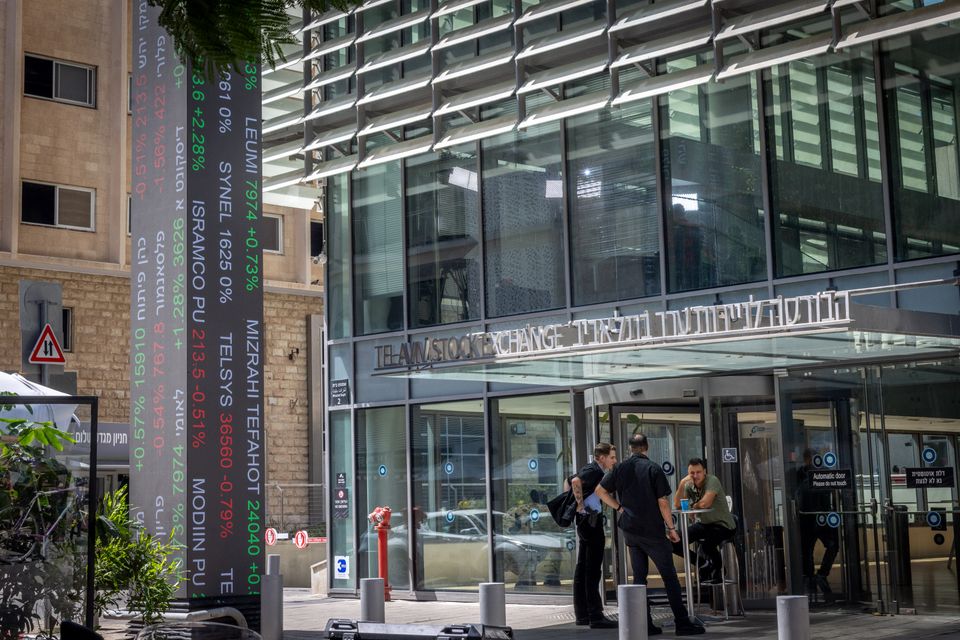
The day after the elections, the index in Tel Aviv fell by about 2%-3%. “Only” 2%-3%, in quotation marks. That figure conceals what really happened. Stocks representing the purely Israeli economy — companies whose entire operations are here — fell much more. By contrast, dual-listed stocks and technology companies, which are less dependent on the local economy, held steady and even rose.
We are seeing polarization between two types of stocks: exporters that depend on the global market, and everyone else. This distinction is the most important thing an Israeli investor needs to understand now.
Why Local Companies in Particular
Political uncertainty is something investors hate in any market, especially in a region that is also unstable from a security standpoint. Even if there is a result, I expect months of turmoil. And this is not just about sentiment. There is a real regulatory problem with project development here: Approvals take 16 to 24 months, even in solar, where the installation itself is the easy part. Many companies talk about projects for which an application has not yet been filed. Those that already hold permits deserve to have a much higher valuation.

An example from the energy sector: Enlight barely fell because nearly all its operations are overseas. Doral fell significantly. It is worth taking a closer look there because a large part of its pipeline is not in Israel, but it has a significant Israeli anchor, so the numbers need to be examined.
Where Greater Caution Is Advisable
Real estate: Exercise a great deal of caution. Not only because of the interest rate, but also because of politics, the overall situation and excess supply in some segments. The crisis in the sector is expected to continue, if not worsen.
Banks: Less because of mortgages and more because of exposure to developers and construction loans.
Israeli defense companies: The outlook is promising, particularly in defense AI, where Israel has a relative advantage and high margins. But they are still trading at very high multiples. Those seeking exposure to the sector will currently find a more attractive entry point among the large American defense companies.
Small-cap stocks: They are often compared with well-known American companies that are 10 to 100 times larger. In practice, because of negligible liquidity and a low public float, their risk parameters are dramatically higher than the Israeli economy reflects. They are not “the proxy” for Israel.
Those who nevertheless believe in the Israeli economy separately from the high-tech sector can consider the financial sector as a proxy for economic activity. But personally, I think the risk-reward ratio in Israel is not high at the moment, and stocks with a much better ratio can be found elsewhere in the world. Perhaps in another month or two.

“Foreign Investors Are Coming In”? It Is Small Change
It was reported this week that foreign investors put about $200 million into the local market. That is one hedge fund’s lottery ticket. During similar periods in the past, inflows were 10 and 20 times greater. Anyone trying to draw a conclusion from this about the world’s confidence in Israel is mistaken. Nor does it mean that foreign investors are right and Israelis are wrong. It makes perfect sense for an Israeli whose local equity portfolio has swelled following the gains to reduce risk during a period of uncertainty. For a foreign investor, Israel is a small slice of a global portfolio, and the expected return is entirely different.
Who Kept the Market Afloat
What saved the market during the recent period, in the face of much sharper shocks, were the institutional investors. Even the portion they keep in Israel operates “on autopilot.” Without them, viewed dispassionately through the lens of Israel’s economy, the declines could have been much sharper. At the same time, I expect the public’s shift to money market funds to continue as long as there is no clarity. And that is understandable.
The Bottom Line
Do not rush. The fact that a stock has fallen does not mean the volatility is over, and we are likely to see it over the next month or two because there is still no decision. Israeli investors who want to remain here need to work company by company, not at the index level: Which companies depend on the local economy, and which hold secured contracts that will remain in place regardless of who wins or who governs. And for those seeking a safety net, global exposure remains the right answer, even if the timing was not perfect for those who moved to Wall Street just before the declines.