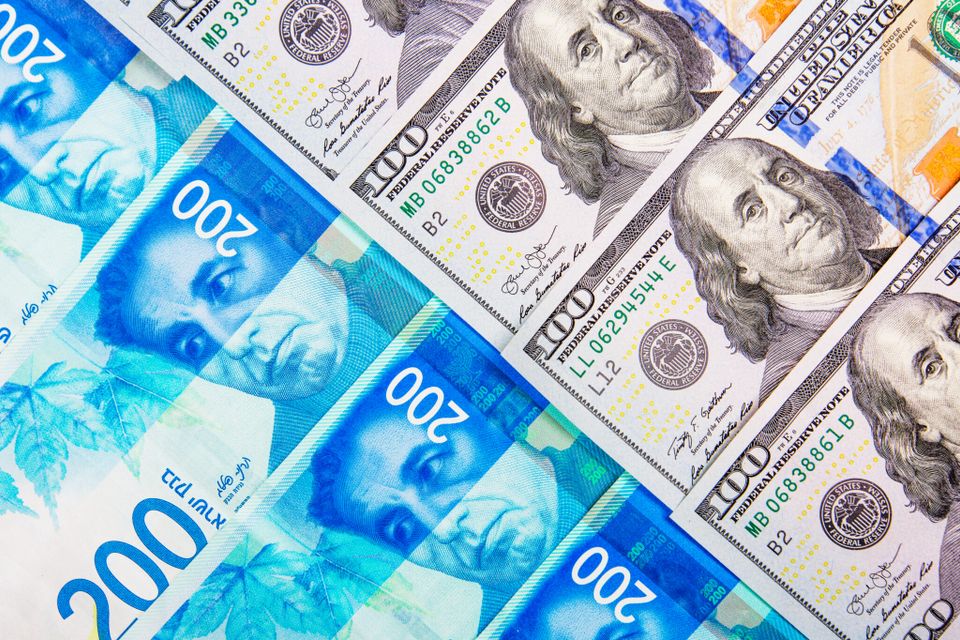
The challenging period currently facing the shekel. In recent days, we have witnessed a depreciation of the Israeli shekel, both against the US dollar and the European euro. Over the past week, the shekel lost 2.5% against the dollar and fell to its lowest level since March. Against the euro, the shekel lost 2.8% during this period.
Two factors can be identified as having negatively affected the shekel:
First, significant declines in US stock indexes, led by the Nasdaq technology stock index, which lost 4.2% over the past week and 8.2% over the past month. These declines translate into a depreciation of the shekel because they force local institutional investors to increase their exposure to the overseas equity component, as directed by their investment committees. Quite a few companies are also taking similar steps.
Second, the domestic political environment following the inconclusive results of the Knesset election and the questions surrounding the government that will be formed, if one is formed — its composition, its policies and the time required to establish it. Foreign investors may adopt a wait-and-see approach until matters become clearer and delay new investments — particularly financial investments — in the local economy.
The coming period may bring greater clarity regarding these two important factors.
Most commentators believe that the midterm elections being held today will lead to a "blue wave" — a Democratic majority in Congress. It is unclear whether the majority in the Senate will also change, but economists fear that such a "wave" would hold back the stock market, particularly in the short term. They attribute this, among other things, to concerns about an increase in the corporate tax rate, a widening of the deficit and tighter regulation — ideas more characteristic of Democrats. In addition, economic policy, which is based on the relationship between Congress and the White House, will be more challenging.
If that happens, it may lead to further declines in the US stock market — at least to the extent they are not already reflected in the latest declines — which would also add pressure on the shekel.
As an aside, after the midterm elections, it will probably become clear whether the Middle East is headed toward renewed military conflict or toward calm and an agreement. In the first case, the dollar's exchange rate worldwide could rise, or strengthen, due to demand for it as a safe-haven currency. In the second case, the dollar's exchange rate could instead fall, or weaken, significantly, again with an emphasis on the short term. A rise in the dollar against this backdrop would also add pressure on the shekel.
A "blue wave" scenario could also renew the rapid rise in yields to maturity on US government bonds. This is because it would result in greater funding needs and an increased supply of bonds. The US government deficit is already very high and is steadily growing. Such a scenario would be particularly difficult for the technology and Big Tech sector, which has extensive capital and fundraising needs and is relatively sensitive to the level of market interest rates.
Domestically, it remains to be seen. A scenario involving another election, for example, to be held in 6 months, would not be welcomed by credit rating agencies, investment houses and foreign investors, which could put even more pressure on the shekel. Conversely, swift agreements and the formation of a new government — one perceived as sustainable and having a clear diplomatic and economic outlook — could certainly cause movement in the opposite direction.
After all, not long ago we saw that the shekel could also reach levels of 2.80 against the dollar.
Either way, the coming weeks will be very important in terms of the classic question: Where is the dollar headed? It is a question that affects a great many economic and financial fronts.