
At first glance, the comparison between BYD and Tesla seems simple: Both companies manufacture electric vehicles, operate in global markets and aim to increase their market share. But each company’s business strategy is developing in a different direction, and these differences are also reflected in their stock valuations.
While China’s BYD is focused on expanding its manufacturing and sales operations worldwide, Tesla is seeking to establish its position in areas including autonomous driving, robotaxi services, humanoid robots and artificial intelligence infrastructure. Therefore, the question for investors is not only which company will sell more cars, but which business model justifies an investment at the current price.
BYD: Global Expansion Based on Manufacturing Advantages
The investment thesis for BYD rests on a relatively established business model: large-scale production, expertise in batteries and electric vehicles, and control over extensive parts of the supply chain. The company is now trying to extend these advantages to markets outside China.
In the first half of 2026, BYD’s revenue from international markets totaled 181.3 billion yuan, compared with 163.5 billion yuan in China. According to the published data, international operations accounted for about 53% of the company’s revenue during the period.
Sales figures from August also point to stronger operations outside China. BYD sold 440,293 new energy vehicles, an increase of 17.8% from August last year. Shipments to international markets surged 134.5% to 189,466 vehicles, while sales in the Chinese market fell 14.3%.
The figures illustrate both the company’s international growth potential and the mounting pressure in its domestic market. In the first half of the year, BYD’s revenue fell 7.1%, and net profit attributable to shareholders declined 20.5%.
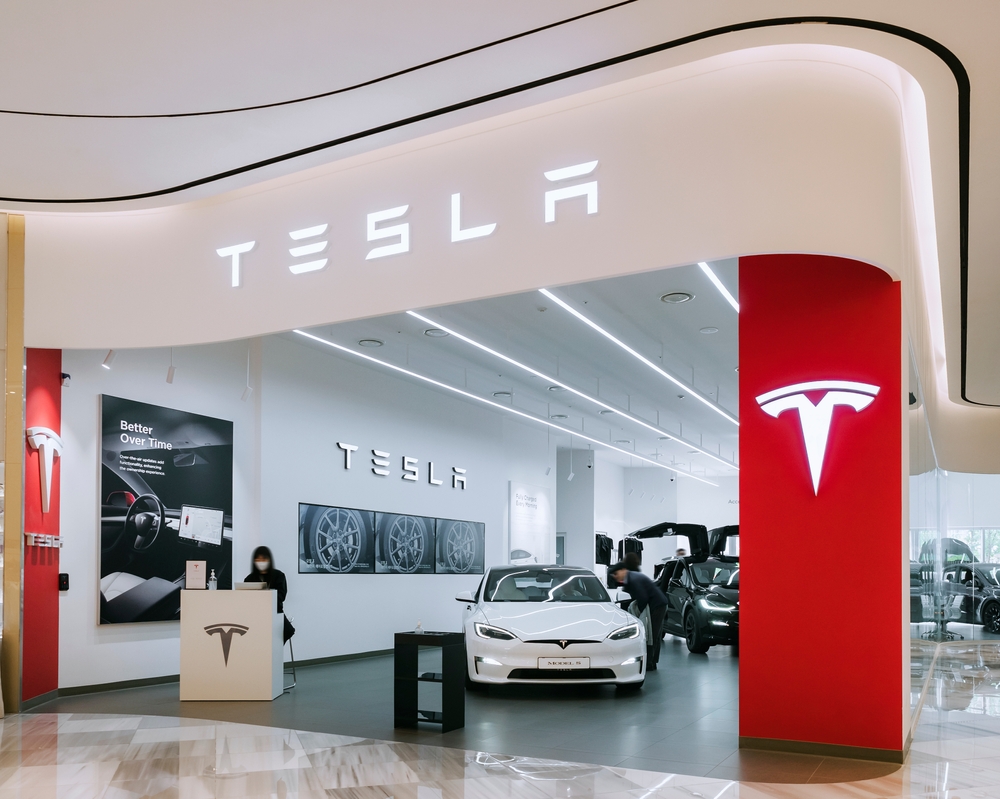
BYD’s main challenge is to turn its cost advantages, battery technology and production scale into sustainable business success in foreign markets. To that end, it is expanding its distribution network and manufacturing infrastructure outside China. Among other initiatives, its first passenger car manufacturing plant in Hungary is moving toward the start of operations.
Successful expansion could reduce the company’s dependence on the competitive Chinese market, but it does not guarantee that growth will necessarily translate into improved profitability. For investors, the bet on BYD is primarily on its ability to execute its business plan and maintain its competitive advantages over time.
Tesla: Investors Are Paying for What May Still Come
Tesla offers a different investment story. Although its automotive operations remain the core of its business, the company is seeking to expand its sources of growth through additional technology fields.
In the second quarter of 2026, automotive operations generated 73% of the company’s revenue, which totaled $28.2 billion. Vehicle deliveries rose 25% to 480,126 units. However, Tesla does not break down the profitability of each of its business segments, making it difficult to determine precisely what share of its profit comes from the automotive business.

At the same time, the company is investing in autonomous driving, robotaxi services, development of the Optimus humanoid robot, and artificial intelligence infrastructure and chips. According to the report, Tesla plans to spend more than $25 billion on capital expenditures during 2026, primarily to expand its new operations.
This means that the existing automotive business could continue generating revenue and funding the development of the new fields, but their success still depends on the company’s ability to turn the investments into significant sources of revenue and profit.
These expectations help explain Tesla stock’s unusual valuation relative to other automakers. According to the data in the original article, Tesla’s sales multiple stands at 12.4, compared with just 1.3 for BYD.
In other words, investors are willing to pay a significant premium for Tesla based on the possibility that the company will expand beyond the automotive business. If robotaxis and artificial intelligence become profitable growth engines, they could justify some of those expectations. On the other hand, delays, investments that fail to yield the expected return or growing competition could make it difficult for the company to justify its valuation.
So Which Stock Is Better?
The answer depends primarily on what type of risk investors are willing to take.
BYD offers exposure to a company that has already built a significant manufacturing operation, possesses technological capabilities in batteries and is expanding its international operations. Its relatively low valuation could interest investors who prefer to focus on the existing business, financial results and the ability to expand operations over time. However, the decline in revenue and profit in the first half of the year shows that this company also faces challenges.
Tesla, by contrast, offers broader exposure to a scenario in which the automaker also becomes a significant player in autonomy, robotics and artificial intelligence. The potential could be substantial, but the valuation also reflects exceptionally high expectations for the success of these initiatives.

Therefore, the comparison between the two is not limited to the question of which company will manufacture or sell more electric vehicles. BYD is primarily a bet on the successful execution of an existing business plan and its expansion into new markets; Tesla is also a bet on the possibility that businesses still in development will become significant growth engines.