
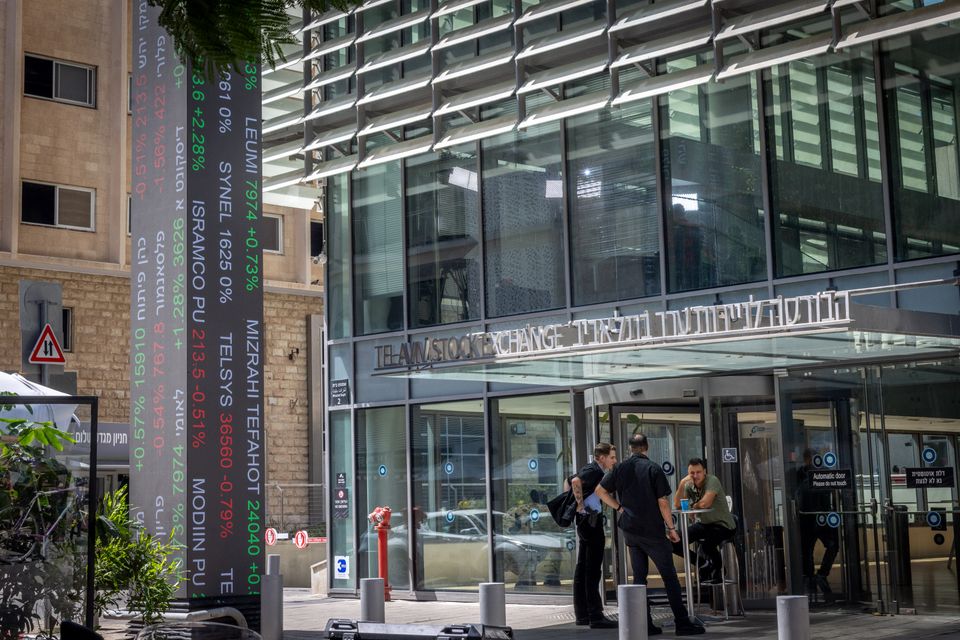
The Tel Aviv Stock Exchange (TASE) closed the final trading day (Monday) before the Knesset election with sharp gains, but the main question is how investors will react when they return to trading Wednesday, after the initial picture of the distribution of seats becomes clearer. Do the gains reflect optimism or pessimism ahead of political change, or has the market already priced in a particular result, leaving little room for surprises?
On Monday, the TA-35 index jumped 1.99%, the TA-125 index rose 1.81% and the TA-90 index gained 1.01%. The gains accelerated throughout the trading day after a negative opening and were led primarily by technology and real estate stocks. The TA-Technology index jumped 3.56%, while Palo Alto Networks surged 9.97%, Tower Semiconductor rose 6.77% and Camtek added 5.54%.
The shekel also continues to show strength: The representative dollar exchange rate was set Monday at NIS 3.078, after falling about 1.1% compared with Friday. However, the gains in the local market cannot be attributed solely to the election. Technology stocks are also affected by global trends and the race to invest in artificial intelligence, while the exchange rate is influenced by a range of domestic and international factors.
Has the market already priced in the election results?
One of the central questions is not only who will win the election, but how different the result will be from the expectations on which current asset prices are based.
According to a Reuters report Monday, some investors believe that a victory by the left-wing bloc, led by Gadi Eisenkot, could support further gains in the local market. Such a scenario could reduce Israel’s risk premium, strengthen the shekel and improve relations with Western allies. Conversely, the absence of a clear outcome could prolong the period of uncertainty and lead to protracted coalition negotiations.
According to the report, JPMorgan estimates indicate the possibility of a move of up to 3% in the shekel, depending on the election results. This is an estimate of possible volatility, not a definitive forecast of the direction of trading.
However, this does not mean that a victory by a particular bloc guarantees gains or losses. Investors will try to understand what the result means in practice: whether a stable government will be formed, what its economic policy will be, how the security burden will be shared and what the implications will be for Israel’s economic relations with the world.
Three scenarios for the day after
1. Victory by the left-wing bloc: A result perceived by the market as reducing political and diplomatic risk could support local stocks and the shekel. Some investors may increase their exposure to Israel, particularly if they believe the result will lead to improved relations with the U.S. and a better business environment. However, if part of the positive scenario is already reflected in prices, the reaction could be more moderate than expected.
2. Continued rule by the current coalition: The reaction depends on the composition of the government, its stability and the policies it presents. If the result differs from market expectations, it could lead to a repricing of Israeli risk, whether positive or negative. Conversely, if investors believe that economic and security policies will not change materially, the reaction could be limited.
3. No clear outcome: This scenario could keep the market on edge. Protracted coalition negotiations and the possibility of another election could increase volatility, particularly if concerns arise about delays to the state budget, economic reforms and decisions affecting the economy. Conversely, the absence of a clear outcome is not necessarily a negative scenario, and the reaction depends on whether the possibility of forming a stable government remains.
These scenarios reflect the areas of risk investors are examining, not a forecast of the political outcome or the direction of the market Wednesday.
What does past experience show?
A study by the research unit at TASE, published ahead of the election, examined stock market behavior after 10 elections held in Israel between 2003 and 2022.
According to the findings, volatility in the leading indices increased by as much as 45% in the weeks following elections compared with a typical trading week. Nevertheless, in many cases the initial declines gave way to a recovery: The TA-125 index delivered an average return of 16.4% in the year after elections, compared with an annual average of 11.5% during the study period.
There was also a subsequent recovery after elections that did not lead to the formation of a government, in which the index fell by an average of 5.3% in the three months preceding the vote. One month after the election, the index posted an average cumulative return of 2.3%.
The data do not guarantee that history will repeat itself, and certainly do not guarantee a positive return on the first trading day after the election. They do indicate that the initial reaction does not necessarily reflect the long-term trend.

Not just the ballot box: What else will move the market?
The election results are only one of the factors that will determine the direction of trading Wednesday. Investors will also continue to monitor trends on Wall Street, particularly the earnings reports of technology giants and the scale of investment in artificial intelligence infrastructure.
At the same time, Israel’s fiscal position will remain in focus: Defense spending, the deficit, the debt-to-GDP ratio and the ability to maintain foreign investors’ confidence could affect the risk premium and the country’s financing costs.

Since the October 7, 2023, massacre attack, TASE has risen about 130%, while the shekel has strengthened about 25%. However, the share of global funds holding Israeli stocks fell to 19%, compared with 34% in 2023, according to Copley Fund Research data cited in the report. The gap between gains in the local market and the decline in foreign funds’ exposure illustrates that stock market performance alone does not necessarily indicate that international investors have returned.
Wednesday will be the first test
There will be no trading on TASE Tuesday because of the election. Trading will resume Wednesday, when investors will react to information accumulated during the day of voting and overnight as the ballots are counted.
Monday’s sharp gains provide a positive starting point, but do not by themselves indicate the next direction of trading. The test will be the gap between the actual result and the expectations already reflected in prices.
If the result is perceived as more positive than expected and reduces uncertainty, the market may continue to rise. If it surprises negatively or prolongs the period of political uncertainty, there could be pressure to take profits and an increase in volatility.