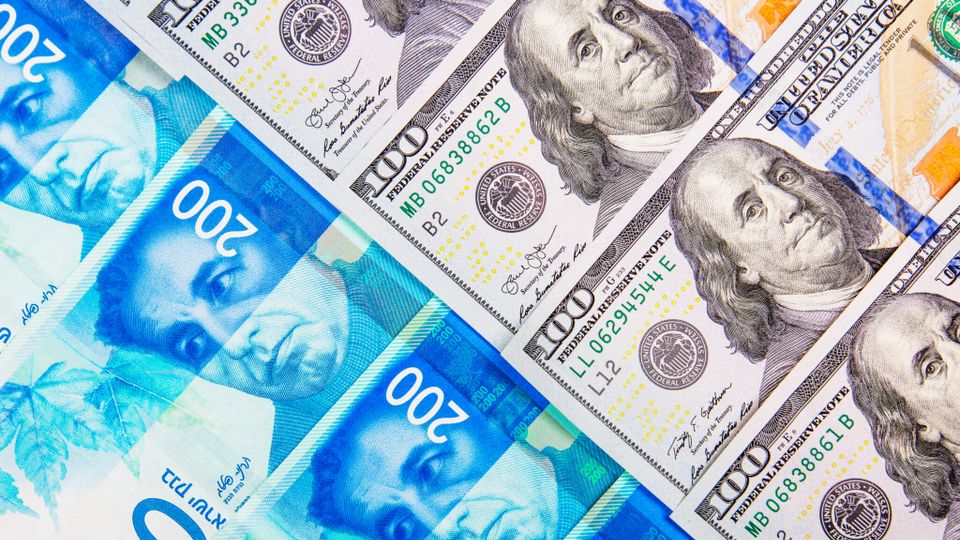
Most attention is focused, of course, on the fact that the interest rate here is falling while interest rates in the United States and Europe are rising, which could make the shekel less attractive. But it must also be taken into account that the shekel is influenced by other factors, such as the current account of the balance of payments, which shifted this year from a surplus to a deficit and is also weighing on the shekel.
The same is true of factors that are not directly related to us, such as U.S. stock markets. When they fall, institutional investors here need to convert shekels into dollars, creating additional selling pressure. And, of course, there is the dollar’s exchange rate worldwide, which could strengthen as the interest rate there continues to rise.
If these three variables act together, a scenario involving shekel depreciation, even significant depreciation, is certainly possible.
However, today in particular, it is worth recalling the factors that still support the shekel:
The economy’s relatively strong growth. The bottom-line GDP figures are much stronger, but I am using cautious language here because of the question of how to treat the significant weight of GDP excluding production adjustments abroad. On the other hand, the economy’s resilience and flexibility in the face of external shocks have once again been demonstrated — a quality that foreign investors, for example, appreciate.
The budget deficit-to-GDP ratio, at 3.2%, is significantly below the target level for 2026 (4.9%) and levels abroad. Here, too, I am cautious because spending could swell later in the year, while revenue could struggle to grow at the pace recorded in the first half of the year. The concentration of exports in sectors with relatively inelastic demand, such as high technology, defense industries and natural gas.
The Bank of Israel’s enormous foreign exchange reserves in GDP terms (about 35%). This is a supportive variable for the State of Israel’s credit rating and, of course, a tool for addressing excessive shekel depreciation if and when the Bank of Israel finds that it exceeds what is warranted by economic factors.
To all these factors, of course, we must add our “neighborhood effect.” But this is a risk factor. Any improvement in the diplomatic and security situation could quickly and powerfully drive shekel appreciation, because economically it is clear to everyone that Israel can play a key role in any future arrangement modeled on the Abraham Accords. Conversely, any deterioration would lead to the opposite result, and here too this is a factor that is not economic in origin and that the economy has very limited capacity to absorb.
When it is difficult to assess where things are headed, it is advisable not to presume to try. But when so many opposing considerations are involved simultaneously, two scenarios can occur:
In one, they will offset one another, and the shekel-dollar exchange rate will not differ materially from its current level. This scenario is reinforced by the fact that, from an economic standpoint as well, the exchange rate is currently considered “fair” — that is, not necessarily excessively appreciated or depreciated.
In the other scenario, factors acting in one direction will be more dominant, pulling the shekel upward or downward, and will probably even create momentum that amplifies the move.
Indeed, the foreign exchange market is among those most affected by momentum moves. The foreign exchange market is highly volatile. The dollar-shekel exchange rate ranged from 2.8 to 3.4 over the past 12 months, a gap of 16%. However, the median rate during this period was 3.09, a gap of just 1.8% from the latest representative rate. Therefore, on the face of it, it may continue to move sideways around current levels.