

Editor’s note:
This week, millions of Jews gathered around the Seder table, recounting the ancient story of the Exodus. It is a festival of liberation, a time to celebrate freedom. Yet, as the Israeli consumer pours the four cups of wine and tastes the bitter herbs, the macroeconomic reality outside the window presents a stark and bitter irony. The modern domestic market is far from a free-flowing land of milk and honey; it has devolved into a rigid landscape heavily guarded by a few dominant corporate gatekeepers.
For the Israeli public, 2026 has brought a different kind of captivity. While the severe geopolitical risks and kinetic realities of the past two years, most recently culminating in Operation Roaring Lion, have rightfully dominated national attention, they have quietly served as something of a macroeconomic smokescreen. The fog of war has allowed Israel’s domestic oligopolies to ruthlessly consolidate power. Geopolitical isolation has effectively walled off foreign competition, creating a captive market and allowing local monopolies to exert unprecedented pricing power over a population buckling under a historic ₪2.5 trillion in private sector debt.
— Sophia Tupolev, TV10 Global Editor
TASE weekly snapshot
The Tel Aviv Stock Exchange closed the week on a positive note.
TA-35 Index (TASE:TA35): 🟢 +2.18%
TA-90 (TASE:TA90): 🟢 +2.05%
TA-125 (TASE:TA125): 🟢 +2.15%
For more details, read our daily editions from Monday to Wednesday - and now, get our video and audio updates on Spotify.
The Pharaohs of the Supermarket Aisle
Nowhere is this structural chokehold more immediately felt than at the grocery store. Preparing this year’s holiday meal laid bare the reality of Israel’s centralized food supply, which is tightly controlled by a handful of massive suppliers and retail chains. Conglomerates like Tnuva, Strauss (TASE:STRS), and Osem-Nestlé, alongside dominant importers Diplomat and Schestowitz, operate as unchecked gatekeepers over the national pantry.
However, the wall is not built by corporations alone; it is reinforced by the Israeli consumer’s own deeply ingrained behavioral patterns. Despite the availability of generic or private label alternatives, the domestic market exhibits an extraordinary level of brand rigidity. For many, the Seder table is not a place for price-discovery, it is a sanctuary for legacy brands. This psychological brand-bondage allows dominant suppliers to hike prices with near-impunity, knowing that the Israeli consumer is statistically less likely to switch to a cheaper competitor than their European or American counterparts. In this environment, consumer loyalty functions less as a preference and more as a voluntary subsidy to the oligopoly.

And there are receipts. The quantitative evidence of this captive market arrived today via SHVA, the administrator of Israel’s national payment system. Data reveals that despite ongoing rocket fire and macroeconomic uncertainty, Passover Eve spending between 08:00 and 15:00 surged to ₪1.015 billion, an 11.3% increase from last year’s ₪912.3 million. At peak volume (12:29 PM), Israelis were executing over 18,000 transactions per minute, spending ₪5.62 million every 60 seconds. While state narratives frequently frame this as ‘consumer resilience,’ in a monopolized, inflationary environment, an 11% spike in credit card volume does not necessarily mean Israelis are consuming more goods; it may mean they are paying a much higher toll for the exact same holiday basket.
While global commodity prices fluctuate, the Israeli consumer is now paying roughly 29% above the OECD average for basic goods. When the country’s largest supermarket chains report quadrupled net profits, and food suppliers casually absorb nominal antitrust fines as the standard 'cost of doing business,' these entities are not merely navigating a national crisis; they are monetizing it. They price their goods with the absolute certainty that no foreign competitor will breach the geopolitical walls to displace them from the shelf.
Captive in the skies, squeezed at the bank

This captive market dynamic extends directly to the skies, where the basic freedom of movement has been heavily restricted. As foreign carriers repeatedly suspend operations citing regional security escalations, El Al (TASE:ELAL) has effectively transformed Ben Gurion Airport into an exclusive toll plaza. While the airline publicly cites complex wartime logistics and insurance premiums, the underlying pricing strategy reflects pure opportunistic extraction.
The regulatory apparatus is finally attempting to quantify this extraction. As we reported, in February 2026, the Israel Competition Authority (ICA) announced its intent to hit El Al with a maximum, unprecedented fine of ₪121 million ($39 million) for ‘excessive and unfair’ price gouging. The ICA’s investigation revealed that as El Al captured a de facto monopoly on 38 of its 53 routes, the carrier hiked average fares by 16%, with certain routes surging by as much as 31%, even marking up partially empty economy flights by 25%
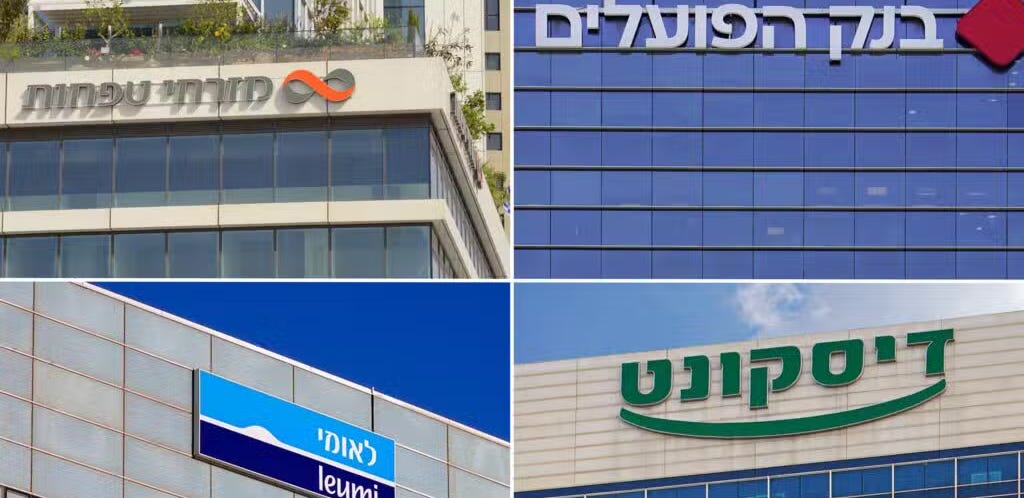
Further up the economic food chain, the banking sector exemplifies the triumph of the oligopoly over the citizen. Bank Leumi (TASE:LUMI) recently posted a staggering ₪10.3 billion net profit for 2025, closely mirrored by Bank Hapoalim’s (TASE:POLI) ₪9.8 billion windfall, boasting return-on-equity (ROE) metrics nearing 16%.
In a normal, frictionless economy, such premium margins would invite fierce disruption. In Israel, they reflect a closed ecosystem that protects incumbents. The high-interest-rate environment, which continues to crush households, serves as a direct, highly efficient wealth transfer mechanism from the public to the banks.
Parting the red tape sea

When the Ministry of Finance points to the resilience of top-line corporate earnings as evidence of sovereign economic strength, it fundamentally mis-prices the reality on the ground. Conflating the monopolistic extraction of a few gatekeepers with the macroeconomic health of the whole is a dangerous misdiagnosis. A booming defense-tech supercycle and record-breaking bank dividends cannot paper over a ₪177 billion crater in lost GDP and a severely paralyzed labor market.
The uncomfortable reality, however, is that the blame for this stagnation rests squarely at the feet of the political echelon. While regulators and CEOs take the public heat, it is the politicians who have consistently chosen the path of least resistance, maintaining the status quo to ensure short-term political stability rather than opening the market to genuine competition. By refusing to advance aggressive, pro-consumer legislation that would dismantle these dynasties, policymakers have effectively prioritized the survival of the cartels over the financial breathing room of the citizen. The current 'captivity' is not merely an economic accident; it is a political choice.
This paralysis is quantifiable. According to new data released this week by the Employment Service, the Israeli labor market has suffered a massive supply-side shock. Since the outbreak of the war, approximately 142,000 new job seekers have registered, pushing the national total to over 304,000. Over 81% of these new registrants (roughly 116,000 individuals) have been placed on unpaid leave (Chalat). The crisis is disproportionately crushing female workforce participation: women account for over 60% of all new job seekers. Mothers of dependent children are the most heavily impacted demographic, surging to 40% of all new registrants (compared to just 23% in March of last year), as their employment stability remains entirely hostage to the ongoing closures of the national education system.
These inflated corporate margins at the top are not a sign of widespread national resilience; they are a symptom of a captive consumer base and a pulverized workforce being aggressively squeezed to subsidize a wartime economy.

Radical, structural reforms are typically executed only when Israel’s back is completely against the wall. Consider the 2011 telecom market overhaul. For years, a deeply entrenched three-firm telecom oligopoly (Partner (TASE:PTNR), Cellcom (TASE:CEL) & Bezeq (TASE:BEZQ)) extracted exorbitant fees from a captive public, shielded by high barriers to entry and draconian exit penalties. It took the largest social protests in the nation’s history, hundreds of thousands of citizens paralyzing the streets over the sheer cost of living, to force political action. Only when faced with a true domestic crisis did the state execute brutal deregulation, aggressively licensing Mobile Virtual Network Operators (MVNOs) and outlawing lock-in contracts. The result was a historic 90% collapse in mobile prices and the immediate destruction of the cartel’s pricing power.
The gravest risk today is regulatory and political complacency fueled by superficial corporate stability. If the government continues to rely on the inflated tax revenues generated by today’s cartels to balance a ballooning wartime deficit, it will inevitably punt on the exact type of politically costly deregulation required to genuinely open the domestic market.
Furthermore, foreign institutional capital will not flood into a closed-loop system simply because the kinetic friction eventually settles. Israel will only attract genuine, sustained post-war investment if it can offer a competitive, frictionless environment rather than a regulatory maze. Projecting a V-shaped economic renaissance is just hype, without forcibly dismantling the banking oligopoly and their workflows, particularly for transfers of capital from abroad which is still not a solved problem, plus aggressively unblocking supply chains.

As the Seder concludes with the traditional declaration, “Next year in a rebuilt Jerusalem,” policymakers must recognize that true institutional rebuilding requires more than just secure borders. A modern, globally integrated economy cannot function while structurally indebted to domestic cartels. The true liberation of the Israeli market demands a final, decisive exodus from the corporate gatekeepers that currently rule it.
That’s our letter, folks. If you enjoyed this Weekly, forward it to a friend.

The English TV10 newsletter is edited by Sophia Tupolev. We love to hear from you.
TV10 Global | Israel for Investors
Now in English: Bringing you the top stories from the Israeli business community, by Israel’s only business and finance network.
Please share your thoughts with us via: global@tv10.co.il or the Newsroom WhatsApp: +972-55-994-5851.
📧 Subscribe to this newsletter! And follow the daily conversation on 𝕏 @tv10global.
Pings with new editions are also available via our WhatsApp Channel.
Disclaimer: This brief is for informational purposes only and does not constitute investment advice. All data is current as of publication date.


