Did you think your pension was diversified? This week, it depended on the fidelity of one man.
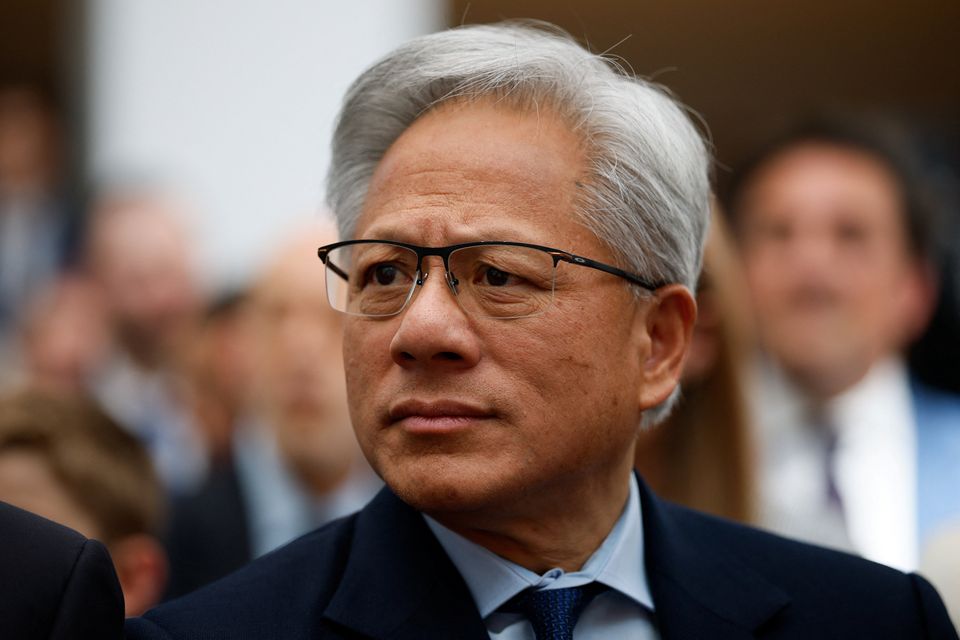
For more than a decade, Jensen Huang, the founder of Nvidia, appeared on every stage in the same black leather jacket. On November 8, he sent a letter to employees whose key sentence was, “I was not faithful to my wife.” Before that, The New York Times reported on a close relationship between him and a senior executive at a data center company whom American officials suspect is a Chinese agent. Reports then emerged of two additional relationships with company employees, which he did not confirm. On November 12, Nvidia announced that the board had accepted his resignation. That day, the stock plunged as much as 16%, and over the course of the week it lost about 11%.

And now for the part you were not told: You are Nvidia shareholders, even if you never bought the stock.
Your Account
Nvidia is the company with the largest weight in the S&P 500, accounting for about 8.5% of it. According to data published in Israel, more than NIS 140 billion from Israelis’ pension, provident and study funds is invested in tracks that follow the index. By a rough estimate, more than NIS 10 billion belonging to Israeli savers was hanging, more or less, on a single hanger. And in household terms: If you have NIS 200 thousand in a study fund on an S&P track, about NIS 17 thousand of it is invested in Nvidia. A decline of 11% in one week means nearly NIS 2,000 was wiped off your balance on paper. That was not because of a poor quarterly report or a trade war, but because of the love life of a CEO in California.
As a consumer behavior researcher, this is the gap that interests me most. We buy an index so that we do not gamble on anyone. In practice, when one company accounts for nearly a tenth of the index and that company is effectively one person, we are gambling on his character. Diversification is partly an illusion.

The Man Who Became a Logo
How did we get here? Through the wardrobe. Jobs was inseparable from his black turtleneck, Zuckerberg from his gray T-shirt and Huang from his jacket. The official explanation is that it saves on decision-making in the morning. The real explanation is marketing. What is repeated becomes familiar, and what is familiar feels safe. A CEO who wears the same garment a thousand times eventually becomes the garment itself.
Want proof? Last July, one of Huang’s leather jackets sold at Sotheby’s for $960 thousand, nearly 16 times the high estimate. No one paid a million dollars for leather. They paid for the legend.
But a logo has one enormous advantage over a human being: It does not cheat. The moment a person becomes a logo, the company inherits his weaknesses as well.

The Market Does Not Forgive a Bad Story
A University of Florida study published in 2025 in the journal Strategic Organization compared dozens of cases in which CEOs were caught engaging in personal misconduct with hundreds of financial scandals at publicly traded companies. The finding: A CEO caught engaging in personal misconduct is five times more likely to be fired than a CEO during whose tenure financial fraud was committed at the company. Boards know how to forgive bad numbers; they do not forgive a bad story.
History has seen this movie before. In August 2010, Mark Hurd, HP’s highly regarded CEO, resigned after an investigation opened following a complaint by an outside contractor. Wall Street loved him for his strong numbers, yet on the first trading day after the announcement, the stock fell about 8%. Within two weeks, about $15 billion was wiped out. The market did not exact a price for the sin. It exacted a price for the void left behind by the man.
Tuesday’s Earnings: What to Watch
The first test is coming quickly. On Tuesday, November 17, after the close of trading on Wall Street, at around midnight Israel time, Nvidia will publish its first quarterly results without Huang. The numbers will be presented by Colette Kress, the interim CEO, who is also chief financial officer.
Three questions will determine whether the market views the affair as merely a passing storm. The first is whether the forecast for the next quarter remains strong or begins to reflect uncertainty. The second is whether the major customers, the cloud giants, confirm their orders or someone asks to “wait and see.” The third is whether the board presents a succession plan or merely another interim CEO.

And there is another date on the calendar: Huang is expected to testify behind closed doors in Congress before Thanksgiving. As long as the question of the Chinese connection remains open, the jacket has not yet returned to the closet.
And for Israeli savers: No one needs to rush to switch tracks because of a single week. But this is a good time to open your annual statement and check how much of your savings actually depends on five or seven CEOs.
The Crown Is Inherited. The Jacket Is Not
Kings once wore crowns so that everyone would know who held the power. Today, billionaires wear leather jackets. The difference is that a crown passes to an heir, while a leather jacket remains on the shoulders of the person who wore it. Nvidia will get back on its feet. It has products, customers and an experienced interim executive. But a personal brand is an incredible growth engine only until it becomes a single point of failure.
The next time a CEO takes the stage in the same outfit for the hundredth time, do not ask what he is wearing. Ask how much of your money he is wearing. Because when the garment betrays, you ultimately pay for it with your own skin.