

🍿 Get our coverage on Spotify, and Youtube, too. Want to join the conversation? We’re on X
Quick takes:
Macro & Fiscal Policy: Bank of Israel Governor Amir Yaron estimates total war costs at ₪405B by 2026; while the Finance Ministry is advancing ‘Pillar 2’ regulations to impose a 15% minimum corporate tax on multinationals.
Tech: Fiverr’s Q1 net income surged nearly 1000% to $8.6M; and Israel ranks second globally in AI adoption.
Commodities: Regulated dairy prices and fuel costs will edge higher in May.
Macro & Fiscal Policy

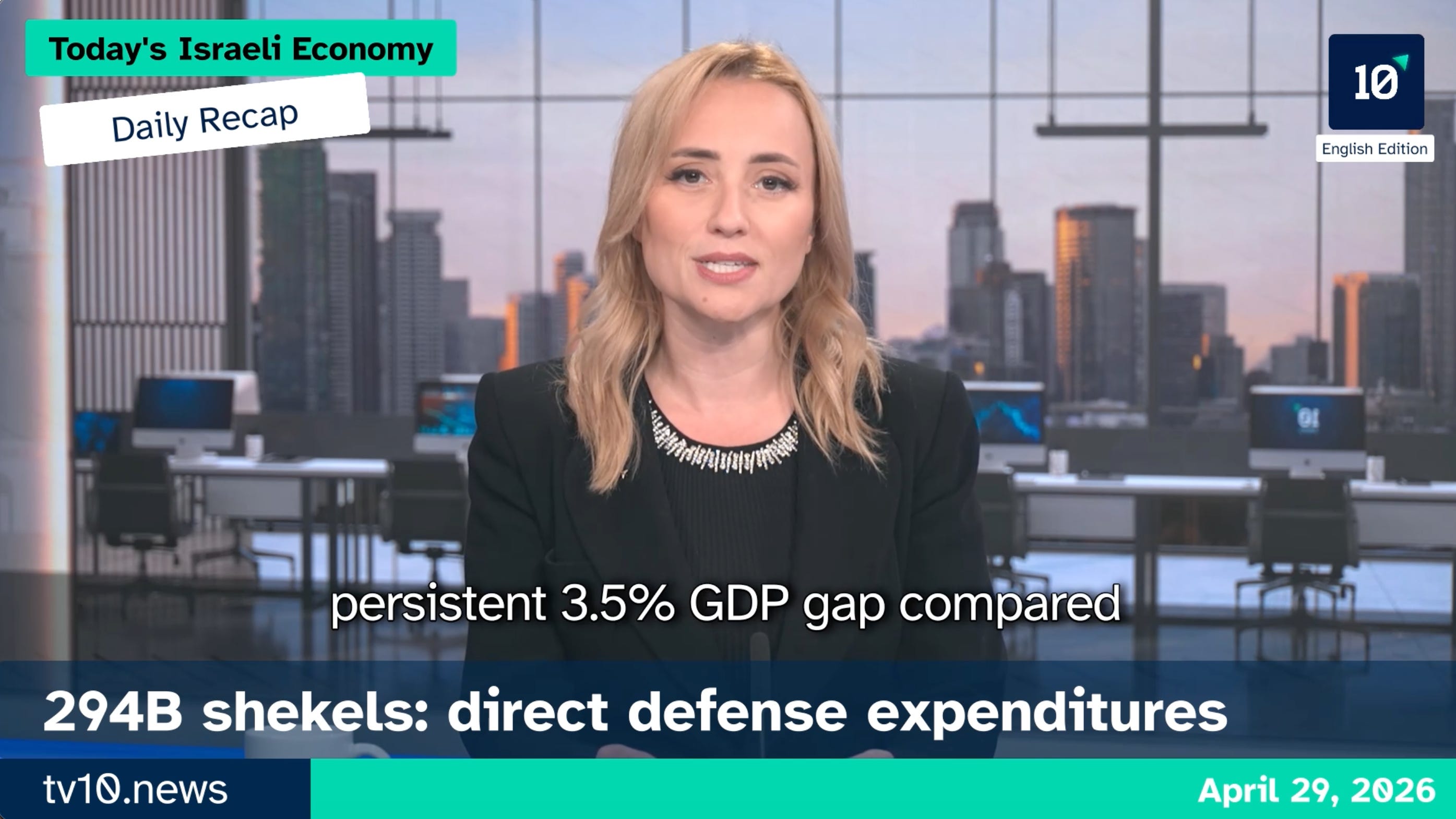
Bank of Israel Governor Prof. Amir Yaron delivered a sober macroeconomic assessment at the Aaron Institute, projecting the total cost of the ongoing multi-front war at ₪405 billion between 2023 and 2026, including ₪294 billion in direct defense expenditures. While noting the economy’s resilience, evidenced by credit card expenditure recovery and a stabilization of Israel’s risk premium (CDS), Yaron highlighted a persistent 3.5% GDP gap compared to pre-war trends. Crucially, the national debt-to-GDP ratio has climbed to 70%, prompting the Governor to explicitly call for a restraint on defense spending and the identification of alternative budgetary sources to force a downward debt trajectory.
The Finance Ministry published draft regulations to implement the OECD’s ‘Pillar 2’ global minimum tax. The framework ensures that multinational corporations generating massive revenues in Israel pay an effective corporate tax rate of at least 15%. To mitigate bureaucratic gridlock, the regulations introduce ‘Safe Harbors’ allowing corporations to rely on existing Country-by-Country reports during a transition period, effectively exempting them from complex supplementary calculations if they already meet a 17% effective tax rate threshold or have negligible local operations.
Our take: The convergence of a 70% debt-to-GDP ratio and the rapid implementation of the Pillar 2 tax framework is not a coincidence; it is a vital defensive maneuver for the state’s fiscal base. With the war deficit ballooning to ₪405 billion, the Treasury can no longer afford to let sovereign revenues leak through jurisdictional arbitrage. By adopting the OECD’s Safe Harbors, the Finance Ministry is minimizing operational friction for foreign multinationals, ensuring Israel remains an attractive FDI destination while aggressively locking down the tax yield required to service its expanding defense debt.
Tech

The Central Bureau of Statistics reported that 39% of Israeli businesses have now adopted artificial intelligence, up sharply from 28% in June 2025. This ranks Israel second globally in AI integration, trailing only Denmark. Adoption is heavily skewed toward the high-tech and financial sectors (65% penetration), where 86% of managers report tangible efficiency gains, and 21% indicate AI is directly replacing routine technical tasks previously handled by human capital.
Fiverr International (NYSE: FVRR) reported its Q1 2026 earnings, showcasing a massive profitability pivot despite top-line stagnation. While quarterly revenue dipped slightly by 1.6% YoY to $105.5 million, net income skyrocketed 975% to $8.6 million. Operating income swung into the black at $8.5 million, compared to a $5.2 million loss last year. The results reflect a strategic shift toward premium enterprise accounts: active buyers dropped 17.8% to 2.9 million, but revenue from clients spending over $1,000 per project grew by 18%.
Our take: Fiverr’s earnings encapsulate the broader transition happening across the Israeli tech ecosystem, as reflected in the CBS data. Faced with a structurally tight and heavily mobilized labor market, Israeli enterprise is executing a ruthless arbitrage of technology over human constraints. Fiverr is actively shedding low-tier retail volume to capture high-margin enterprise yield, effectively expanding its EBITDA while serving fewer clients.
Commodities

The Ministry of Energy announced a minor 2-agora increase in regulated fuel prices for May 2026, bringing 95-octane gasoline to ₪8.07 per liter. The Energy Administration noted that a 6% spike in international refined fuel prices was largely absorbed and offset by a 5% appreciation of the shekel against the US dollar.
Separately, food giant Tnuva announced a 1% price hike on state-regulated dairy products and a slightly higher increase for butter, citing the rising cost of raw milk fat inputs.
Our take: While Israel’s headline inflation remains below the OECD median, the localized cost-of-living matrix remains notoriously sticky. The slight uptick in fuel and regulated dairy highlights the structural vulnerability of the Israeli consumer to imported commodity shocks and domestic agricultural oligopolies. While the strong shekel acted as a critical FX buffer this month to absorb the global energy shock, the systemic lack of domestic competition continues to allow conglomerates to pass marginal input costs directly onto the consumer with zero friction.
TASE snapshot for Wednsday, April 29, 2026
TA-35 Index (TASE:TA35): 🟢 +1.19%
TA-90 (TASE:TA90): 🟢 +1.59%
TA-125 (TASE:TA125): 🟢 +1.28%
If you enjoyed this update, forward it on.
TV10 Global | Israel for Investors
Bringing you the top stories from the Israeli business community, by Israel’s only business and finance network.
Share your thoughts with us via: global@tv10.co.il or the Newsroom WhatsApp: +972-55-994-5851.
📧 Subscribe to this newsletter! And follow the daily conversation on 𝕏 @tv10global.
Pings available via WhatsApp Channel.
Disclaimer: This brief is for informational purposes only and does not constitute investment advice. All data current as of publication date.


