

🍿 Get the Daily on Spotify, too
Quick takes:
Macro: March credit card spending reached ₪47.955B (+0.7% YoY) despite Operation Roaring Lion; The labor market suffered a massive supply-side shock with 142k new job seekers registering since the war began.
Tech & Defense: WeSure Global Tech secured ₪116.5M in a private placement; Aryt Industries booked a ₪42M Ministry of Defense contract; NextVision secured an additional $5.5 million order.
Capital Markets: Retail investors are defying institutional panic, pivoting from foreign stocks back to local indices; The mutual fund industry absorbed ₪4.5B in March.
Macro

The Israeli consumer continues to spend through the sirens, even as the labor market fractures. According to new data from SHVA (Automatic Bank Services), total credit card expenditures in March 2026 reached ₪47.955 billion, a 0.7% increase (roughly ₪340 million) over the same period in 2025. While the daily average spend of ₪1.547 billion represents a slight 3.6% dip from February 2026, it remains a staggering 11% higher than the daily average recorded during Operation Am Kelavi in June 2025.
Simultaneously, the human capital cost of Operation Roaring Lion is reaching a breaking point. The Employment Service reported that 142,209 new job seekers have registered since the start of the conflict, bringing the national total to 304,635. Notably, 81.7% of these new registrants (approximately 116,217 people) are on unpaid leave (Chalat).
Our take: We are witnessing a brutal, dual-front squeeze on the Israeli middle class. While SHVA frames the spending figures as a testament to Israeli resilience, the persistent 11% spike in daily spending is likely less a sign of consumer confidence and more a reflection of the inflationary toll of a monopolized market. The public is paying a geopolitical premium on basic goods simply because they have no cheaper alternatives.
Compound this captive spending with a massive supply-side labor shock, and the structural risks become glaring. The motherhood penalty in Israel has morphed into a severe macroeconomic liability. As the government relies on education closures to manage the home front, it forces working families to absorb the severe economic cost of the home front, crushing dual-income households through lost wages. The blame for this paralysis rests squarely with the political echelon, which has failed to deregulate the consumer market to lower costs, while simultaneously failing to implement the institutional support systems required to maintain a dual-income economy during a prolonged emergency.
Tech & Defense

WeSure Global Tech (TASE:WESR) announced a successful ₪116.5 million private placement today, attracting top-tier institutional backing. The round included investments from Menora Mivtachim (TASE:MMHD) (₪25.5M), Migdal (TASE:MGDL) (₪17M), and the Schestowitz Group (₪34M). The shares were allocated at ₪17, a discount to the previous closing price of ₪19.07. This follows a ₪150 million raise in December 2025 and positions the company as a strong candidate for the TA-125 index.
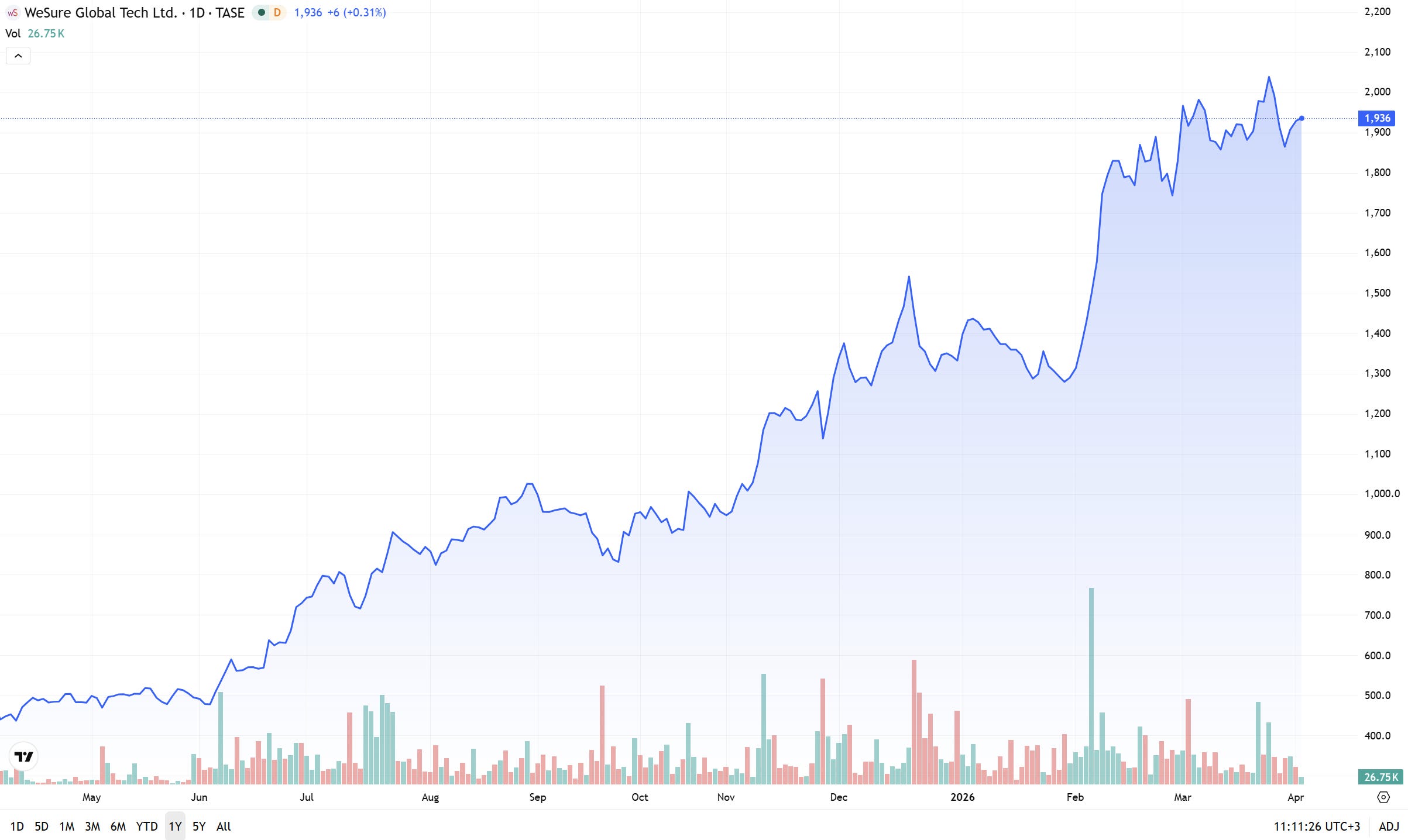
Our take: Even in the shadow of Operation Roaring Lion, the private placement market for growth-tech remains liquid for firms with a clear path to profitability. WeSure's 45% YTD rally demonstrates that investors are hungry for InsurTech disruptors that can streamline legacy financial systems. By bringing in institutional heavyweights like Menora and Migdal, WeSure is cementing its status as a national champion in the digital insurance space. However, for the broader tech ecosystem, the reality remains heavily bifurcated: for every mature tech firm that secures institutional funding, dozens of smaller startups are facing canceled rounds and operational paralysis due to the ongoing conflict's strain on human capital.

Aryt Industries (TASE: ARYT) announced today that its subsidiary, Reshef Technologies, secured a ₪42 million order from the Israeli Ministry of Defense to supply electronic fuzes. Deliveries are scheduled between October 2026 and February 2027. This domestic procurement pushes Aryt's backlog to a staggering ₪750 million, which includes a conditional $52.5 million order from India’s Bharat Electronics Limited (BEL), and sent the stock jumping 4.4% in early trading. Following a record 2025 with a ₪347 million net profit, CEO Chaim Stefler noted the company is leveraging its operational stability to aggressively expand into European and NATO markets, whilst developing next-generation fuzes for UAVs and loitering munitions.
Our take: Aryt Industries highlights the other primary engine of the current defense supercycle: precision munitions. As Israel learns the hard lessons of localized supply chain dependency during a prolonged multi-front war, domestic procurement from firms like Aryt is surging to replenish depleted stockpiles. Furthermore, with European and NATO defense budgets expanding in response to broader geopolitical instability, Aryt's move into next-generation loitering munitions perfectly positions the company to export its "battle-tested" components to Western militaries scrambling to modernize their artillery systems.

NextVision (TASE: NXSN), an Israeli developer and manufacturer of day/night stabilized camera systems for aerial and ground vehicles, reported a new $5.5 million order today. Under the terms of the agreement, 15% of the consideration was paid as an advance, with the remainder due before final delivery, slated for completion by the end of Q3 2026. This latest contract pushes the company’s total order intake for the first quarter of 2026 to over $120 million. This comes on the heels of a blockbuster 2025 that saw the company’s net profits surge 56% to $103.6 million, supported by a massive $288 million backlog.
Our take: NextVision's financials read more like a high-margin enterprise SaaS company than a defense hardware manufacturer. A 62% net profit margin is virtually unheard of in traditional defense contracting, reflecting immense pricing power, a highly scalable proprietary technology (their patented stabilization engine), and an exceptionally tight supply-demand imbalance in the global tactical drone market. As kinetic conflicts increasingly rely on localized, high-resolution aerial ISR (Intelligence, Surveillance, and Reconnaissance), NextVision is successfully converting a severe regional security crisis into record-breaking, export-driven cash flow.
Capital Markets
Despite the geopolitical volatility, retail investors are proving to be the market’s ultimate “shock absorbers.” According to new data from Meitav Investment House, the Israeli mutual fund industry recorded ₪4.5 billion in net inflows during March. However, the composition of these flows reveals a highly defensive, localized posture. Shekel-denominated money market funds dominated, absorbing a massive ₪4.35 billion, while dollar-denominated funds saw outflows of ₪450 million.
Traditional active management also saw a resurgence, raising ₪2.1 billion (led by government and general bond funds). Conversely, passive funds bled ₪1.5 billion, driven heavily by a ₪1.1 billion exodus from foreign equity funds as global markets corrected (the S&P 500 and Nasdaq fell 5.1% and 4.8% respectively in March, compared to a mild 0.7% dip in the TA-35). Despite the net inflows, total industry AUM shrank from ₪791 billion to ₪780 billion due to ₪15.4 billion in market depreciation. This corroborates data from the Fair platform, which noted a 51% surge in domestic equity trading volumes as retail players shift away from global exposure to capitalize on local valuations they perceive as a long-term recovery arbitrage.
Our take: Retail investors are currently betting on the day after while institutional players are more inclined to hedge abroad. This pivot back to local assets suggests a high level of confidence in the underlying strength of the Israeli economy, but it also highlights a dangerous behavioral trap. The Israeli consumer’s rigid loyalty to local recent market success, specifically the record-breaking dividends of domestic oligopolies and the defense supercycle, creates a severe macroeconomic blind spot. By aggressively buying into the top-line growth of local banks, insulated retail conglomerates, and aerospace firms, retail investors are exhibiting a powerful recency bias.
TASE snapshot for Monday, April 6, 2026
TA-35 Index (TASE:TA35): 🔴 -1.89%
TA-90 (TASE:TA90): 🔴 -2.32%
TA-125 (TASE:TA125): 🔴 -1.98%
If you enjoyed this update, forward it on.
TV10 Global | Israel for Investors
Bringing you the top stories from the Israeli business community, by Israel’s only business and finance network.
Share your thoughts with us via: global@tv10.co.il or the Newsroom WhatsApp: +972-55-994-5851.
📧 Subscribe to this newsletter! And follow the daily conversation on 𝕏 @tv10global.
Pings available via WhatsApp Channel.
Disclaimer: This brief is for informational purposes only and does not constitute investment advice. All data current as of publication date.


